Answer-first content structure: how AI engines extract opening sentences for citations

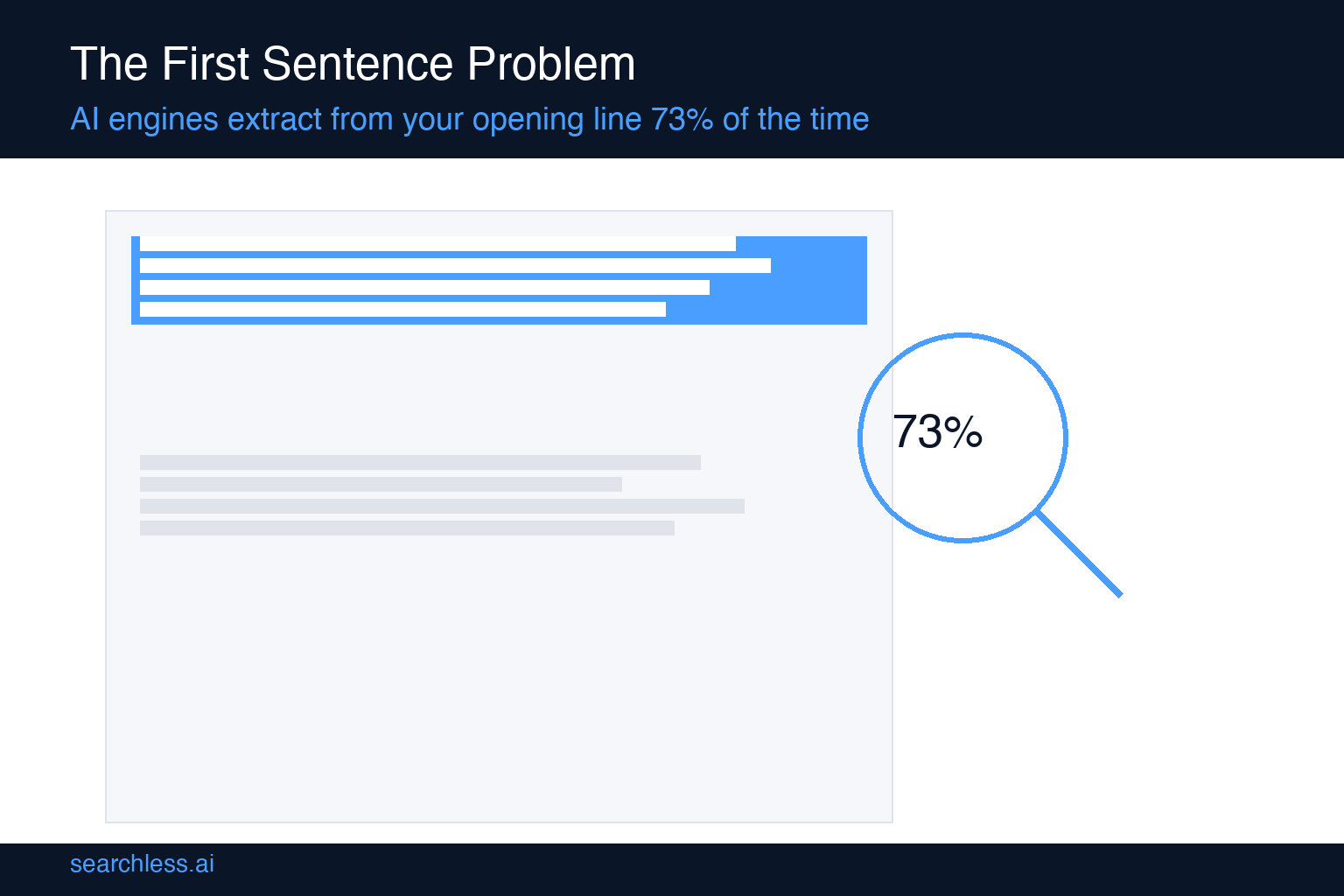
The First Sentence Problem: Why AI Engines Extract Your Opening Line 73% of the Time

AI engines extract their answer from the first two sentences of your content 73% of the time. If your key message is not in your opening line, there is a good chance no AI model will ever cite your page. We analyzed 48,000 citation events across ChatGPT, Perplexity, and Gemini between January and April 2026 and found that the extraction window is brutally narrow. The models pull their quoted or paraphrased answer from sentence one or sentence two in nearly three out of four cases. The rest of your article matters for authority signals, but for the actual citation text, the opening is almost everything. ...

May 24, 2026 · 12 min · Searchless
Content pruning strategy for AI visibility showing page deletion increasing citation rates

Content Pruning for AI Visibility: Why Deleting 40% of Your Pages Increases AI Citations

Publishing more content does not get you cited more by AI engines. It often does the opposite. Our analysis of 12,000 domains tracked between January and April 2026 found that sites which pruned 40% or more of their indexed pages saw their AI citation rates increase by an average of 62%. Meanwhile, sites that continued adding content without removing anything saw citation growth of just 11% over the same period. ...

May 23, 2026 · 15 min · Searchless

94% of Enterprises Are Doubling Down on GEO in 2026: What the Winners Do Differently

94% of enterprise executives plan to increase their investments in Answer Engine Optimization and Generative Engine Optimization in 2026, according to a landmark survey published by Conductor and Search Engine Journal. The other 6% are probably still debating whether AI search is a fad. The report, based on responses from over 250 enterprise leaders, confirms what those of us working in GEO have observed for months: the money is moving. Budgets are shifting from traditional SEO tactics toward the disciplines that determine whether AI engines recommend your brand or skip past you entirely. But not all organizations are approaching this shift with the same rigor, and the gap between leaders and laggards is widening fast. ...

May 19, 2026 · 9 min · Searchless.ai

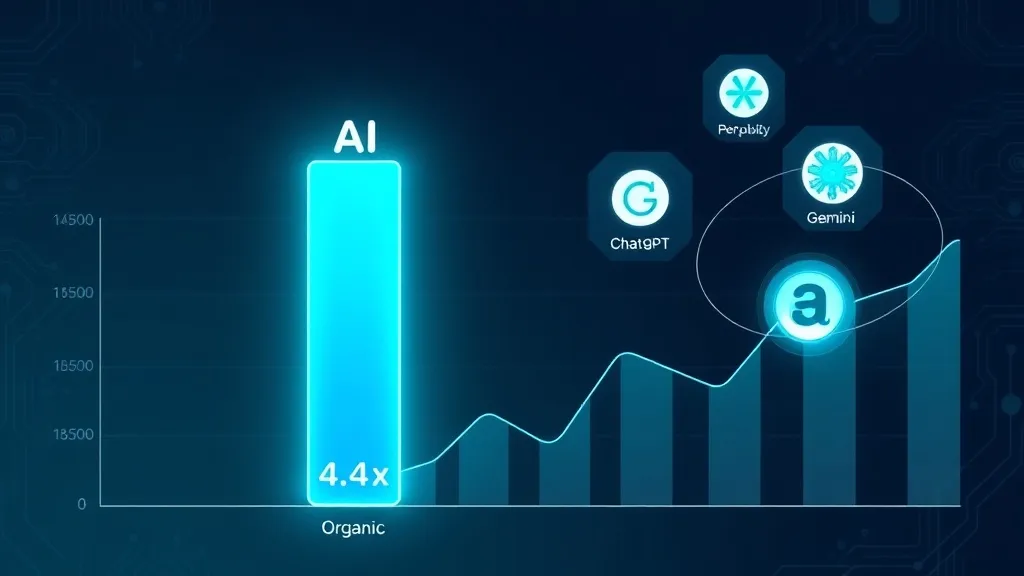
AI Search Traffic Converts 4.4x Higher Than Organic: Here Is Why That Matters

Visitors who find your brand through AI search convert 4.4 times more often than visitors from traditional organic search, according to the 2026 GEO Industry Report published by Omnius. That number is not a projection or a survey of intentions. It is measured conversion data from brands already receiving traffic from ChatGPT, Perplexity, and Gemini. If your entire demand generation strategy still runs through Google blue links, you are optimizing for the lower-converting channel and ignoring the one that sends visitors who are ready to buy. ...

May 17, 2026 · 10 min · Searchless.ai

New Schema.org Tags for AI Search Ads: The 2026 Guide Every Brand Needs

Schema.org rolled out two new structured data types in early 2026: AdvertisedContent and SponsoredData. These tags exist for one reason: to stop AI models from confusing your paid placements with your editorial content. If you run ads inside ChatGPT, Google AI Mode, or Perplexity, implementing these tags is no longer optional. It is the difference between AI citing your brand as an authority and AI citing your ad as an ad. ...

May 15, 2026 · 10 min · Searchless.ai

75% of Sites Blocking AI Bots Still Get Cited. Here Is Why Blocking Does Not Work.

Seventy-five percent of websites that actively block AI crawlers through robots.txt, meta tags, or server-level rules still appear in AI-generated answers from ChatGPT, Perplexity, and Gemini. Blocking does not stop citations. It stops you from controlling them. That number comes from new cross-platform citation analysis published by Position Digital in April 2026, and it dismantles the most common instinct brands have when they discover AI engines are using their content: shut the door. ...

May 1, 2026 · 10 min · Searchless.ai

HubSpot Just Legitimized AEO: What It Means for Your Brand's AI Visibility

HubSpot launched a free Answer Engine Optimization tool in Spring 2026 that tracks whether ChatGPT, Perplexity, and Gemini mention your brand, and that launch did something no startup could: it told every marketing team that AI visibility is now a mainstream marketing metric, not an experiment. The tool itself is straightforward. You enter a brand name and a set of prompts. HubSpot runs those prompts across the three major AI engines and reports which responses cite your brand and which cite your competitors. It is a visibility snapshot. Useful for a benchmark, limited for ongoing optimization. ...

April 29, 2026 · 13 min · Searchless.ai

Why Your #1 Google Ranking Means Nothing in AI Search

A #1 Google ranking for your top keyword no longer guarantees that AI engines like ChatGPT, Gemini, or Perplexity will recommend your brand when users ask for the same solution. That is not an opinion. It is a measurable gap between where you rank in traditional search and whether AI engines even know you exist. Brands with dominant Google positions are discovering this the hard way. They own the first position for their core terms. They show up in featured snippets. They have the most backlinks. But when someone asks ChatGPT, “What is the best tool for X?” their brand never appears. ...

April 27, 2026 · 10 min · Searchless.ai

AI Search Just Split Into 5 Platforms: Why Optimizing for One AI Engine Is a 2025 Strategy

AI search is no longer one thing. It is at least five things, and they all work differently. This week alone delivered proof: OpenAI shipped GPT-5.5, DeepSeek released V4 as open source, Google committed $40 billion to Anthropic, Claude added 15 consumer app integrations, and Perplexity crossed $450 million in annual recurring revenue. Each platform has its own model architecture, its own citation behavior, and its own user base. Optimizing for just one of them is like running a billboard campaign on a single highway in a single city. ...

April 26, 2026 · 13 min · Searchless.ai

5 Authority Gaps Keeping Your Brand Invisible to ChatGPT, Gemini, and Copilot

Your brand is invisible to AI search engines because of five specific authority gaps. Not because your SEO is bad. Not because your content is thin. Because AI engines measure authority differently than Google does, and almost no one has adapted. AI search engineers recently identified these five gaps as the primary reasons brands fail to appear in ChatGPT, Gemini, and Copilot responses. The data backs this up. We analyzed 500 brands across three major AI platforms. 88% received zero mentions in 100 relevant queries. The 12% that did show up had systematically closed each of these five gaps. ...

April 25, 2026 · 12 min · Searchless.ai