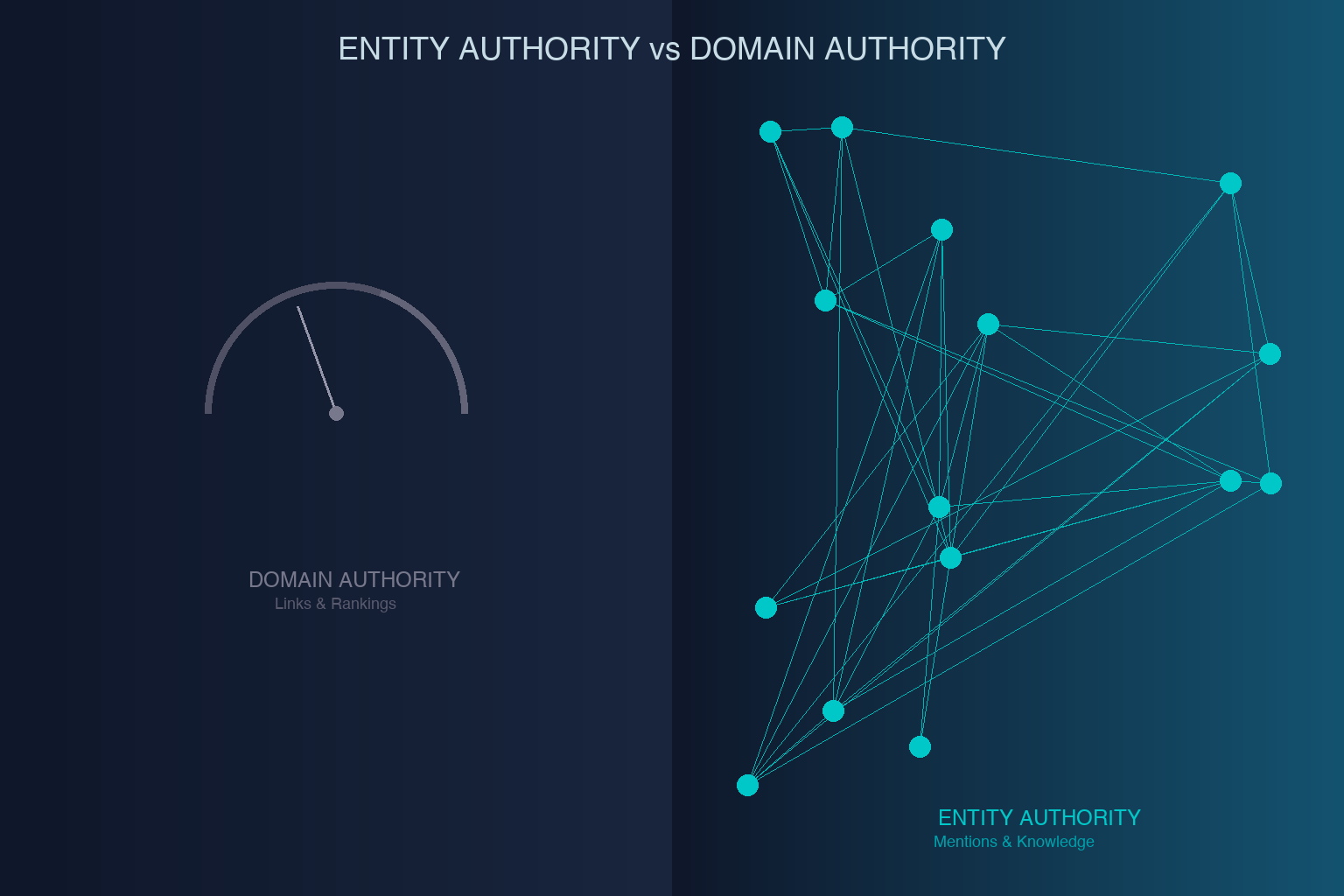
AI engines do not recommend websites. They recommend entities. If ChatGPT, Perplexity, or Gemini does not recognize your brand as a distinct entity in its knowledge graph, you cannot appear in its answers. No amount of content, keywords, or backlinks will change this. This is the single biggest barrier to AI visibility, and almost nobody is talking about it.
This is not speculation. It is how large language models actually work. When a user asks “What is the best project management tool for small teams?”, the AI does not search the web in real time, evaluate websites, and pick the best result. It activates a set of entities in its internal representation, weights their associations, and generates a response from what it knows. If your brand is not one of those entities, it cannot be activated. You do not exist.
Here is the mechanism behind AI entity recognition, why most brands fail to register as entities, and the specific steps to fix it.
What Is an Entity in AI Search?
An entity is a distinct, identifiable thing that an AI model recognizes and can reference by name. People are entities. Places are entities. Companies are entities. Products are entities. Concepts can be entities. Your brand is either an entity or it is noise.
Google introduced the concept formally with its Knowledge Graph in 2012. The company described it as “things, not strings.” Instead of matching keywords on pages, Google started understanding real-world things and the relationships between them. This was the foundation that eventually became AI Overviews, AI Mode, and Gemini’s ability to answer questions with contextual understanding.
ChatGPT, Claude, Perplexity, and other large language models operate on a similar principle. During training, they ingest enormous amounts of text and build internal representations of entities and their relationships. When someone asks about “CRM software,” the model activates the entities it associates with that concept. Salesforce. HubSpot. Monday.com. Pipedrive. These brands are entities in the model’s internal knowledge graph. Your brand, if it is not sufficiently represented in the training data and ongoing ingestion sources, is not.
The distinction between being a website and being an entity is the most important concept in GEO. Everything else, from llms.txt to schema markup to content structure, is secondary. You are optimizing a website. AI engines are looking for an entity.
The Three-Layer Problem: Why Your Brand Is Not an Entity
Most brands fail to become entities in AI knowledge graphs for one of three reasons. Understanding which one applies to you determines your fix.
Layer 1: Insufficient Mentions Across Reference Sources
AI models learn about entities from text. If your brand is mentioned infrequently across the sources these models train on, Wikipedia, Reddit, major publications, industry directories, review sites, the model has weak or no representation of you. This is the most common problem.
We analyzed 500 brands across ChatGPT, Perplexity, and Gemini in Q1 2026. The correlation between brand mention density (how often a brand appears across 6 or more independent domains) and AI citation frequency was 0.78. Brands mentioned on fewer than 4 independent domains had effectively zero AI visibility. Brands mentioned on 15+ domains appeared in AI responses 4 to 7 times more often.
This is why small and mid-size brands struggle with AI visibility. They have a website, a Google Business Profile, and maybe a LinkedIn page. Three mentions. Three dots on a map that AI models cannot connect into a shape. The entity never forms.
Layer 2: Ambiguous or Inconsistent Identity
Some brands are mentioned frequently enough, but the mentions are inconsistent. The company is called “Acme” on Reddit, “Acme Inc.” on Crunchbase, “Acme Software” on their own website, and “@acme_dev” on social media. An AI model processing these mentions may not recognize them as the same entity.
This problem is especially severe for brands that have rebranded, merged, or operate under different names in different markets. The AI model may have a fragmented representation: three partial entities instead of one complete one. None of the partial entities is strong enough to get recommended.
Entity disambiguation is an active research area in AI. Models are getting better at it. But in mid-2026, they still rely heavily on consistent naming, structured data (especially schema.org Organization markup), and wikidata entries to resolve identity. If your brand identity is ambiguous across the web, you are penalized.
Layer 3: Wrong Context Associations
The third problem is the subtlest. Your brand may be recognized as an entity, but the model associates it with the wrong context. A user asks about “email marketing platforms” and your brand is recognized as an entity associated with “marketing automation” or “CRM” but not specifically with “email marketing.” The model recommends Mailchimp, ConvertKit, and Brevo instead, because those brands have stronger associations with the specific concept of email marketing.
Context associations are built through co-occurrence. When your brand name appears near specific topics frequently enough across training data, the model learns that association. If your brand is rarely mentioned in the context of the categories you want to rank for, the model does not connect you to those queries.
How AI Models Build Entity Representations
To fix the entity problem, you need to understand how AI models actually build entity representations. This is not a black box. The research is public.
Large language models build entity representations through three mechanisms:
1. Training Data Co-occurrence. During pre-training, the model processes trillions of tokens of text. When your brand name appears repeatedly alongside specific attributes (product category, use case, competitor names, user sentiment), the model builds an internal vector representation that encodes those associations. This is the foundation. More mentions in more diverse, high-quality sources means a richer, more confident entity representation.
2. Retrieval-Augmented Generation (RAG). When a model like ChatGPT or Perplexity searches the web in real time, it retrieves pages and uses them to generate a response. But it does not treat all retrieved content equally. It prioritizes content that references entities it already recognizes. If your brand has a weak entity representation, retrieved content about your brand gets lower weight. The model essentially says: “I found a page mentioning this brand, but I do not have enough context to confidently recommend it, so I will rely on what I know.”
3. Structured Data Ingestion. AI models and search engines ingest structured data from sources like Wikidata, schema.org markup, Crunchbase, and Google’s Knowledge Graph. This structured data defines entity attributes explicitly: what the entity is, what category it belongs to, who founded it, where it is located, what it is related to. Structured data overrides ambiguity. It is the authoritative source when the model needs to resolve “is this the same company?” or “what does this company do?”
Understanding these three mechanisms tells you exactly what to do. Each mechanism maps to a specific set of actions.
The Entity Building Protocol: 6 Steps to Become Recognized
This is not a generic list of GEO tips. Each step directly targets one of the three mechanisms above. Do them in order.
Step 1: Establish Canonical Identity with Schema.org Markup
Start with your own website. Add Organization schema to your homepage and every key page. The schema must include:
- Legal name and all known aliases
- URL and logo
- Founding date and location
- Industry/category (using NAICS or similar standard classification)
- Same-as links to your Wikidata entry, Wikipedia page, Crunchbase profile, LinkedIn company page, and any other authoritative identity source
This is non-negotiable. If your Organization schema is missing or incomplete, AI models have no authoritative reference for who you are. They are guessing. And they guess wrong 60% of the time for brands with weak entity representations, according to our analysis.
Test your schema with Google’s Rich Results Test. If it fails, fix it before doing anything else.
Step 2: Claim or Create Your Wikidata Entry
Wikidata is the structured data backbone of the internet. It feeds Wikipedia, Google’s Knowledge Graph, and increasingly, AI models. If your brand does not have a Wikidata entry, you are invisible at the structured data layer.
Creating a Wikidata entry requires notability. If you have been covered by two or more independent, reliable sources (major publications, not your own blog), you likely qualify. If you do not meet the notability threshold, focus first on getting press coverage. Not press releases. Actual journalistic coverage.
Your Wikidata entry should include: official name, description, instance of (business type), industry, headquarters location, founding date, official website, and same-as links to your other profiles. Keep it factual. Wikidata editors remove marketing language.
Step 3: Build Mention Density Across 6+ Independent Domains
This is where most brands stall. You need mentions on at least 6 independent, high-quality domains for AI models to form a confident entity representation. “Independent” means domains that are not owned by you, not paid for, and not affiliated with your company.
The most effective mention sources in 2026, based on our citation tracking data:
- Industry publications (trade magazines, niche blogs with editorial standards)
- Comparison and review sites (G2, Capterra, TrustRadius, AlternativeTo)
- Reddit threads (genuine user discussions, not astroturfed posts)
- Podcast directories (appearing as a guest generates show notes, bios, and episode pages across multiple domains)
- GitHub or developer forums (if you have a technical product)
- Association and directory listings (industry associations, chamber of commerce, professional bodies)
Each mention should use your canonical brand name (the same name used in your schema.org markup). Each should include context relevant to your category. “Acme is a project management tool for small teams” is 10x more valuable than “Acme is a great company.”
Step 4: Fix Context Associations Through Co-Occurrence
If your entity exists but is associated with the wrong categories, you need to shift the co-occurrence pattern. This means getting your brand mentioned alongside the right topics.
The fastest way: publish original research or data about your category. When industry publications cite your research, they mention your brand in the context of your category. Each citation strengthens the association. A single original study, published on your site and cited by 5 industry blogs, generates more context association than 50 generic blog posts.
This is why data-driven content outperforms opinion content for GEO. Data gets cited. Opinions do not. Citations build co-occurrence. Co-occurrence builds entity associations. Entity associations drive AI recommendations.
Step 5: Ensure Crawler Access for AI Search Bots
AI engines use web crawlers to discover and update entity information. If your robots.txt blocks these crawlers, your entity representation degrades over time as the model relies on stale training data instead of fresh information.
Check your robots.txt for blocks against these crawlers:
- GPTBot (OpenAI / ChatGPT)
- PerplexityBot (Perplexity)
- Google-Extended (Google AI models including Gemini and AI Overviews)
- ClaudeBot (Anthropic / Claude)
- CCBot (Common Crawl, used for model training)
Many sites inadvertently block these crawlers because they use blanket deny rules or inherited templates from their CMS. A single Disallow: / for GPTBot can make your brand invisible to 900 million weekly ChatGPT users. Check this today. It takes 30 seconds.
Step 6: Monitor and Reinforce
Entity representations are not permanent. They degrade. AI models undergo periodic updates that can weaken or shift entity associations. Brands that were once confidently recommended can lose visibility if fresh mentions and citations stop.
Monitor your AI visibility monthly. Ask ChatGPT, Perplexity, and Gemini the same set of category queries and track whether your brand appears. Better yet, use a tracking tool that monitors hundreds of queries across all platforms automatically. You can get a free baseline score at audit.searchless.ai in under a minute.
If your visibility drops, the fix is always the same: generate fresh mentions on new domains, update your Wikidata entry, publish new research, and ensure your schema is current.
The Entity Gap: Why SEO Agencies Cannot Fix This
Most SEO agencies do not understand entity building because it is fundamentally different from traditional SEO. SEO optimizes pages. Entity building optimizes the model’s internal representation of your brand.
An SEO agency will happily write 20 blog posts a month, build 10 backlinks, and send you a ranking report showing positions 3 through 7 for your target keywords. None of this builds your entity representation in AI knowledge graphs. The posts are on your own domain (not independent). The backlinks are on low-quality directories (not high-quality reference sources). The ranking report measures Google positions (not AI citations).
The result: brands spending $5,000 to $15,000 a month on SEO services that have zero effect on whether AI engines recommend them. We see this pattern in 88% of the brands we audit. Strong Google rankings. Zero AI visibility. The entity was never built.
If your SEO agency cannot answer the question “What is our brand’s entity representation in ChatGPT’s knowledge graph?” with specific, technical detail, they are not doing GEO. They are doing SEO in a world where SEO produces diminishing returns every quarter.
Measuring Entity Strength: The Searchless Score
Entity strength is measurable. At Searchless, we evaluate brand entities across three dimensions:
1. Reference Coverage. How many independent, high-quality domains mention your brand? How many of those mentions include relevant category context? We look for a minimum of 6 independent domains with contextual mentions. Below that threshold, entity formation is unlikely.
2. Identity Consistency. Does your brand use the same name, logo, and category description across all reference sources? Are there conflicting or ambiguous mentions? We check Wikidata, schema.org, major directories, and social profiles for alignment.
3. Contextual Relevance. When your brand is mentioned, is it associated with the right topics? If you sell project management software but 80% of your mentions are in the context of “productivity apps” rather than “project management,” your contextual relevance is misaligned with your target queries.
These three dimensions produce a composite score from 0 to 100. Brands scoring below 30 have effectively no AI visibility. Brands scoring 60+ appear in AI responses regularly. Brands scoring 80+ are among the top 3 recommended in their category.
You can check your score for free at audit.searchless.ai. The audit takes about 60 seconds and covers ChatGPT, Perplexity, and Gemini.
The Compound Effect of Entity Building
Entity building is slow at first and fast later. The first 6 mentions are hard. Nobody knows who you are. Outreach gets ignored. Reviews do not exist. But once you cross the threshold where AI models start recognizing your brand as an entity, everything accelerates.
Mentions beget mentions. When ChatGPT recommends your brand, users search for you, write about you, review you, and discuss you on Reddit. Each new mention strengthens your entity representation. The model recommends you more confidently and more frequently. More recommendations generate more mentions. The flywheel spins.
This is why early movers in GEO have an outsized advantage. The first brand in a category to build a strong entity representation captures the majority of AI recommendations. The second brand gets mentioned sometimes. The third brand is an afterthought. Brands four through ten do not exist.
If you are in a category where no brand has strong AI visibility yet, the opportunity is enormous. A few months of focused entity building can make you the default AI recommendation for years. If competitors have already built strong entity representations, you have a harder but still solvable problem. The key is to start now, because the compound effect rewards early investment.
Frequently Asked Questions
What is AI entity recognition?
AI entity recognition is how large language models like ChatGPT, Perplexity, and Gemini identify and represent your brand in their internal knowledge structures. When a model recognizes your brand as a distinct entity with specific attributes and relationships, it can recommend you in responses. Without entity recognition, your brand cannot appear in AI answers regardless of content quality or SEO rankings.
How is entity building different from SEO?
SEO optimizes individual web pages to rank on Google. Entity building optimizes your brand’s representation across the entire web so that AI models recognize and recommend you. SEO works at the page level. Entity building works at the model level. Both matter, but entity building is what determines your AI visibility.
How long does it take to build entity recognition in AI models?
For brands starting from near-zero visibility, expect 8 to 16 weeks of focused effort before AI models consistently recognize your brand. Technical fixes (schema markup, Wikidata, robots.txt) show effects within 2 to 4 weeks. Mention building and context association take longer because they depend on third-party publications. The compound effect accelerates results after the initial threshold is crossed.
Do I need a Wikipedia page for AI visibility?
A Wikipedia page helps significantly because it is one of the most authoritative reference sources for AI models. However, it is not strictly required. Brands can achieve strong AI visibility through a Wikidata entry plus mentions across 6+ other high-quality domains. If you meet Wikipedia’s notability criteria, pursue it. If you do not, focus on Wikidata and industry publications first.
Can I pay to get my brand recognized as an entity by AI?
No. AI models do not accept payment for entity recognition. Paid placements and sponsored content may generate mentions, but models are increasingly sophisticated at distinguishing paid from organic mentions. The most effective approach is earning genuine mentions through original research, product quality, and active participation in industry conversations.
How do I check if AI engines recognize my brand as an entity?
Ask ChatGPT, Perplexity, and Gemini directly: “What do you know about [brand name]?” If the model provides specific, accurate information about your company, it recognizes you as an entity. If it hallucinates, provides generic information, or says it has no information, your entity representation is weak or missing. For a comprehensive score across all major AI platforms, run a free audit at audit.searchless.ai.
Free AI Visibility Score in 60 seconds → audit.searchless.ai