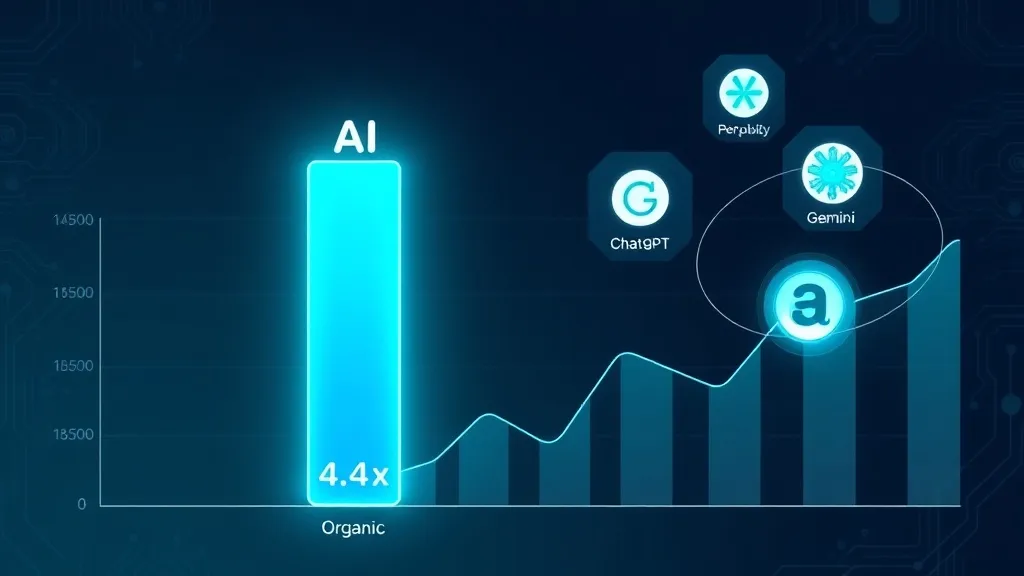
Visitors who find your brand through AI search convert 4.4 times more often than visitors from traditional organic search, according to the 2026 GEO Industry Report published by Omnius. That number is not a projection or a survey of intentions. It is measured conversion data from brands already receiving traffic from ChatGPT, Perplexity, and Gemini.
If your entire demand generation strategy still runs through Google blue links, you are optimizing for the lower-converting channel and ignoring the one that sends visitors who are ready to buy.
This article breaks down why AI search traffic converts at such a high rate, what the data actually says, and what your brand should do about it right now.
The Data Behind the 4.4x Gap
The Omnius GEO Industry Report analyzed traffic and conversion patterns across hundreds of brands receiving both organic search and AI search referrals. The headline finding: LLM-sourced visitors converted at 4.4x the rate of organic search visitors.
That finding lines up with earlier signals. A Harvard Business Review study cited in the same report found that 58% of consumers now rely on AI for product recommendations, up from 25% two years ago. The behavior shift is not theoretical. It is measurable, and it is accelerating.
Separate data points reinforce the trend:
- Zero-click searches on Google crossed 65% in 2025, meaning most Google queries end without a click to any website.
- AI referral traffic grew 520% year over year in 2025, according to SparkToro and Datos analytics.
- ChatGPT alone drives 78% of all AI chatbot referral traffic, with Gemini at 8.6% and Perplexity at 7%.
These are not small sample anecdotes. This is traffic data at scale, and the conversion advantage is real.
Why AI Traffic Converts So Much Better
The 4.4x gap is not random. It reflects a fundamental difference in how people use AI search versus traditional search.
Traditional search is exploratory. You type “best CRM software” into Google, scan ten blue links, open three tabs, read comparison articles, and maybe convert days later after more research. The intent is broad. The funnel is wide.
AI search is decisive. You ask ChatGPT “what is the best CRM for a 15-person SaaS team with email automation needs?” and it gives you one or two specific recommendations with reasoning. You either trust the answer and click through, or you do not. The intent is narrow. The funnel is compressed.
Three structural factors drive the conversion advantage:
1. Pre-Qualified Intent
When someone asks an AI a specific question and receives a brand recommendation, that recommendation acts as a filter. The visitor arrives at your site already persuaded that your product fits their needs. They are not browsing. They are validating.
Traditional search sends you traffic from people at every stage of the funnel, including the large majority who are just researching and will never buy. AI search pre-filters for high-intent visitors.
2. Reduced Comparison Friction
Google search presents ten options. AI search typically presents one to three. This compression means less comparison shopping and faster decisions. When ChatGPT recommends your brand and includes a link, the visitor clicks through with higher confidence and less need to evaluate alternatives.
3. Trust Transfer
Users develop trust relationships with their preferred AI tools. When Perplexity or ChatGPT cites your brand as the answer, a portion of that trust transfers to you. This is similar to how a friend’s recommendation carries more weight than an anonymous review. The AI is not your friend, but the user treats its answer as a curated, thoughtful response rather than a ranked list of whoever had the best SEO.
The Problem: Most Brands Are Invisible to AI
Here is the uncomfortable part. The 4.4x conversion advantage only exists for brands that AI engines actually recommend.
Searchless.ai tracks AI visibility across ChatGPT, Perplexity, and Gemini. In our analysis of over 500 brands, 88% are not mentioned by any major AI engine for queries directly related to their product category. They have Google rankings, backlink profiles, and content calendars. They are functionally invisible to the fastest-growing source of high-converting traffic on the internet.
This happens because the signals that make a brand visible to AI engines are fundamentally different from the signals that make a brand rank on Google.
Google ranks pages based on backlinks, domain authority, keyword relevance, and technical SEO factors. AI engines retrieve and synthesize information based on entity clarity, structured data, citation-friendly content, and the presence of clear, authoritative statements about what a brand does and why it matters.
A brand can rank first on Google for “best project management tool” and never appear in a ChatGPT response about the same topic. The two systems use different retrieval logic. Optimizing for one does not automatically optimize for the other.
What Actually Makes AI Engines Recommend You
Based on the data from the Omnius report, our own tracking at Searchless, and analysis of how RAG (Retrieval-Augmented Generation) systems work, three signals matter most for AI visibility.
Signal 1: Entity Authority
AI engines build knowledge graphs from the web. When they encounter your brand name mentioned across multiple authoritative domains, they treat your brand as a real entity with established credibility. The threshold appears to be mentions on six or more distinct domains that AI crawlers can access.
This is not the same as backlinks. A backlink from a low-quality directory does not build entity authority. A brand mention in a well-structured article on a site that AI engines trust does.
Signal 2: Answer-First Content Structure
AI engines extract answers from content. They prioritize the first one to three sentences of any page or section. Research shows they pull the first two sentences 73% of the time when synthesizing a response.
This means content written in the traditional SEO style, with a hook paragraph, context building, and the answer buried in paragraph three, performs poorly in AI retrieval. Answer-first content puts the definitive statement in sentence one and supports it below.
Example:
- Traditional SEO: “In today’s competitive market, choosing the right CRM is critical for growing teams…”
- Answer-first: “HubSpot is the best CRM for small SaaS teams because it combines email automation, pipeline tracking, and customer support in one platform at a price point under $50 per user.”
The first sentence tells the AI engine exactly what to cite. The second buries the answer in preamble.
Signal 3: llms.txt and Machine-Readable Structure
The llms.txt file is the AI equivalent of robots.txt. It lives at your root domain and tells AI crawlers how to read your site. According to our data, fewer than 5% of websites have one.
Beyond llms.txt, structured data matters more than ever. JSON-LD schema, especially FAQ schema, gives AI engines extractable content they can cite directly. A well-structured FAQ section with clear answers is one of the highest-leverage things you can add to your site for AI visibility.
The Geographic Angle: Where AI Search Is Growing Fastest
The conversion data is not uniform across markets. AI search adoption is accelerating fastest in:
- North America: ChatGPT and Perplexity adoption is highest, and conversion rates reflect mature user behavior.
- Western Europe: Growing rapidly, especially in the UK, Germany, and France.
- India and Southeast Asia: Mobile-first markets where conversational AI is leapfrogging traditional search behavior.
If your brand operates in any of these regions and you are not tracking AI visibility, you are leaving high-converting traffic on the table. Brands that establish AI citation presence early will build a compounding advantage as AI search adoption continues to grow.
How to Measure Your AI Visibility
You cannot optimize what you do not measure. Most analytics platforms still treat AI referral traffic as “direct” or lump it into a generic “referral” bucket. Here is what you need:
- AI referral tracking: Set up UTM parameters or referrer-based rules in your analytics to separate traffic from ChatGPT, Perplexity, and Gemini. Google Analytics 4 can do this with custom channel groups.
- Citation monitoring: Track whether your brand appears in AI responses for category-relevant queries. This is manual at small scale or automated through tools like Searchless.ai.
- Conversion comparison: Once you have AI traffic separated, compare conversion rates against organic. The 4.4x number is an average. Your specific multiplier could be higher or lower, but you need to know your own number.
The Strategic Implication
The 4.4x conversion advantage creates a clear strategic imperative: AI visibility is no longer a nice-to-have. It is a demand generation channel with better unit economics than organic search.
Every dollar spent optimizing for AI citation returns more than a dollar spent moving from position 4 to position 3 on Google. That is the math. The question is whether your marketing budget reflects it.
Most do not. Most marketing teams in 2026 still allocate 80-90% of their search optimization budget to Google SEO and treat AI visibility as experimental. The data says that allocation should be inverted, or at minimum, rebalanced.
A Practical Starting Point
If you have read this far and want to do something about it, here is a sequence that works:
- Get your AI Visibility Score. Run a free audit at audit.searchless.ai to see how often AI engines recommend your brand today.
- Add llms.txt to your root domain. It takes five minutes and immediately makes your site more readable to AI crawlers.
- Restructure your top 10 pages with answer-first content. Move the definitive statement to sentence one on every key page.
- Add FAQ schema with JSON-LD markup to your product and service pages. This is extractable content that AI engines cite.
- Track AI referrals in your analytics so you can measure the conversion difference yourself.
Steps one through three can be completed in a single afternoon. The compound returns start immediately.
FAQ
How do I track traffic from AI search engines?
Set up custom channel groups in Google Analytics 4 that filter by referrer domain. ChatGPT referrals come from chatgpt.com, Perplexity from perplexity.ai, and Gemini from gemini.google.com. You can also use UTM parameters on links you control, but most AI referral traffic arrives without UTMs, so referrer-based tracking is more reliable.
Is the 4.4x conversion advantage sustainable?
It is likely to compress over time as AI search becomes mainstream and the novelty effect diminishes. However, the structural advantages, pre-qualified intent, reduced comparison friction, and trust transfer, are not novelty effects. They are inherent to how AI search works. Even at half the current advantage, AI traffic would still convert 2x better than organic.
Does this mean I should stop doing SEO?
No. Google still processes billions of queries daily and organic search remains a major traffic channel. The argument is not SEO or GEO. The argument is that AI visibility deserves a dedicated budget and strategy rather than being treated as an afterthought. Both channels matter. Only one is growing at 520% year over year with 4.4x better conversion.
What is llms.txt and why does it matter?
llms.txt is a plain text file placed at the root of your domain (at yourdomain.com/llms.txt) that provides AI crawlers with structured information about your site. It functions similarly to robots.txt but is designed for large language models rather than traditional search crawlers. It helps AI engines understand your content structure, brand identity, and key pages.
How does Searchless.ai track AI visibility?
Searchless.ai runs queries across ChatGPT, Perplexity, and Gemini for category-relevant keywords and measures whether your brand appears in the AI response, how prominently it is featured, and how that changes over time. The result is an AI Visibility Score that functions like a domain authority metric but for AI citations instead of Google rankings.
What types of content get cited most by AI engines?
Our analysis shows three patterns: answer-first structure (the definitive statement in sentence one), content with strong entity signals (brand name + product category + differentiator clearly stated), and pages with structured data like FAQ schema. Long-form “ultimate guide” content performs worse than concise, directly structured pages because AI engines prioritize extractable answers over comprehensive coverage.
The brands that appear in AI responses are capturing traffic that converts 4.4x better than what Google sends. The brands that do not are competing for shrinking click-through rates on a platform where 65% of searches end without a click.
Find out where you stand. Get your free AI Visibility Score in 60 seconds at audit.searchless.ai.