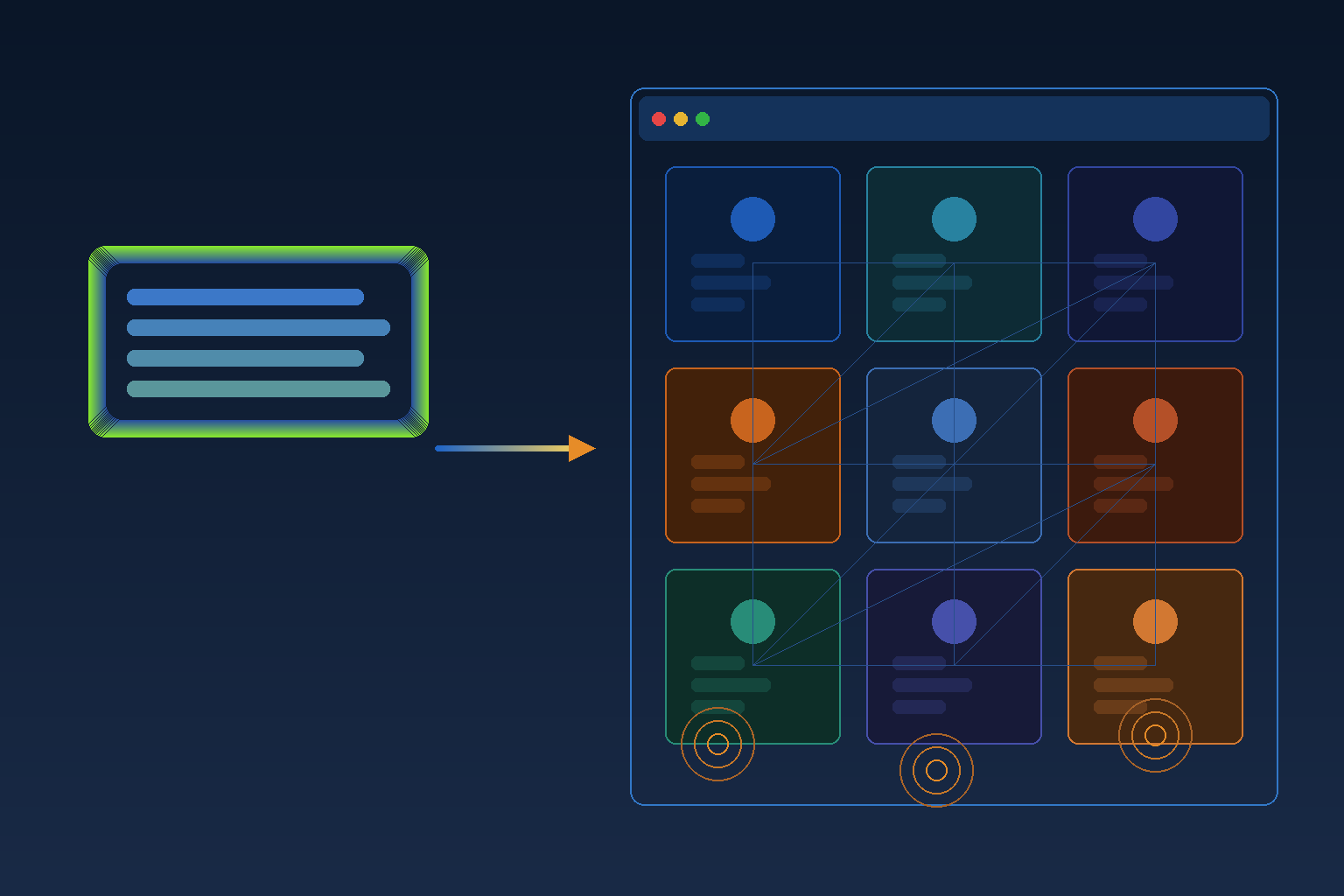
OpenAI is about to turn ChatGPT from a chat interface into an agent-first superapp, and a senior OpenAI employee told the Financial Times plainly: “Chat is dead.” The redesign, rolling out in the coming weeks, unifies Codex coding tools, AI agents, and third-party apps into a single platform. If your brand strategy depends on being mentioned in a ChatGPT conversation, you are optimizing for the version of ChatGPT that is about to be replaced.
This is not a UI refresh. It is a fundamental repositioning of the platform that 1 billion people use every month. The implications for brand discovery are massive, and most marketing teams have not started thinking about them.
What Is Changing
The current ChatGPT experience is built around a single paradigm: you type a question, the model generates a text response, and you read it. That interface made sense in 2023. It already feels dated in mid-2026.
The new ChatGPT is being restructured around three pillars.
Agents that act. Instead of answering questions, ChatGPT will dispatch agents that complete tasks. Book a flight. Research a product. Compare vendors. Generate a report. The user does not read an answer and then act. The agent acts directly.
Third-party apps inside ChatGPT. OpenAI is building an app ecosystem within the ChatGPT interface. Third-party services can integrate directly, similar to how WeChat mini-programs or Apple App Store apps work within their parent platforms. Users discover and use these apps without leaving ChatGPT.
Unified workspace. Codex (the coding agent), the research agent, the shopping agent, and the general-purpose assistant all become surfaces in one platform. The user moves between them seamlessly.
The shorthand from inside OpenAI is blunt: chat was the onboarding experience. The product is becoming an operating layer for getting things done.
Why This Matters for Brand Discovery
If you have been doing GEO (Generative Engine Optimization) at all, you have probably been focused on one thing: getting ChatGPT to cite your brand in its text responses. That is a reasonable goal in the current interface. The user asks a question, ChatGPT generates an answer, and if your brand is in that answer, you win.
But in a superapp model, discovery works differently. Here is how the shift breaks down.
From Citation to Integration
In the chat model, your brand appears as a name in a sentence. “For CRM software, consider Salesforce or HubSpot.” That is a citation. It drives awareness and, sometimes, a follow-up search.
In the agent model, your brand can appear as an action. The user says “set up a CRM for my team,” and the agent might open a third-party HubSpot app inside ChatGPT and walk through the setup. Your brand is not cited. It is integrated. The discovery happens through a functional connection, not a text mention.
This is a categorical upgrade in commercial value. A citation builds awareness. An integration captures the user mid-task with zero friction to conversion.
From Answer to Transaction
In the current model, ChatGPT recommends a product and the user leaves to buy it. In the superapp model, the purchase can happen inside the platform. ChatGPT becomes a transaction layer, not just an information layer.
For brands, this means GEO is no longer just about content optimization. It is about API integration, app listing optimization, and being present in the decision path of an AI agent that has the authority to act.
From One Surface to Many
Today, you optimize for one ChatGPT experience: the chat response. Tomorrow, you need to think about at least four surfaces where your brand can appear or be invoked.
- Agent task flows. When an agent researches a category, does it know your brand?
- App directory. When users browse third-party apps, is yours listed and optimized?
- Shopping surfaces. When the shopping agent compares products, are you in the comparison?
- Research surfaces. When the research agent generates reports, does it cite your data?
Each surface has its own optimization logic. Each is a new channel that did not exist six months ago.
The IPO Accelerant
This transformation is not happening in a vacuum. OpenAI filed its S-1 the same week as the Financial Times report on the superapp redesign. The company is preparing for a public market debut, and that changes the incentive structure.
Public companies need revenue growth. ChatGPT’s subscription revenue alone will not satisfy public market expectations. The path to accelerating revenue runs through the app ecosystem: transaction fees, premium app placements, advertising, and commerce partnerships.
Expect monetization to arrive faster than it would at a private company with infinite runway. The combination of platform redesign plus IPO pressure means that paid discovery inside ChatGPT could arrive within months, not years.
Brands that establish organic presence in the new surfaces early will have an advantage when paid options arrive, exactly like the early Google Ads adopters who built quality scores before the auction got expensive.
What Brands Should Do Right Now
This is not theoretical. The redesign is rolling out in “coming weeks,” per the FT report. Here is a concrete preparation checklist.
1. Audit Your Current AI Visibility
Before you can prepare for the new surfaces, you need to know where you stand on the current ones. Run an AI visibility audit across ChatGPT, Perplexity, and Gemini. See how often your brand appears in responses for your core category queries. If you are invisible today, you will be invisible in the new surfaces tomorrow.
Use the free AI visibility score tool to get a baseline in about 60 seconds.
2. Structure Content for Agent Extraction
Agents do not read your blog like a human. They extract structured information. Your content needs to be formatted for machine extraction, not just human consumption.
The key signals that make AI systems cite you are documented in our guide to what content gets cited by AI. The short version: answer-first formatting, entity clarity, structured data (JSON-LD schema), and topical authority across a coherent knowledge graph.
This matters more now, not less. Agents still need source material to make decisions. The agent might act on behalf of the user, but it still needs authoritative content to inform that action.
3. Prepare for App Integration
If you have an API, document it. If you have a developer platform, make sure it is accessible. The third-party app ecosystem inside ChatGPT will favor brands that can be integrated programmatically.
Start thinking about what a “ChatGPT app” version of your product looks like. What is the core interaction that an agent could facilitate? What data can you expose that makes your product more useful inside an agent workflow?
4. Build Entity Authority Across the Web
AI agents do not just read your website. They synthesize information from across the web. The more your brand is mentioned across diverse, authoritative domains, the more likely agents are to surface you in their decision-making.
Our analysis of entity authority as the new domain authority shows that brands mentioned across 6 or more distinct domains are 3.2 times more likely to be cited by AI engines than those with strong single-domain presence.
Entity authority is the foundation. Without it, your app integration and content optimization efforts will underperform.
5. Monitor Multiple AI Surfaces, Not Just One
If you are only tracking ChatGPT text responses, you are tracking the past. Start monitoring:
- ChatGPT agent task completions (when available)
- Perplexity citation patterns
- Google AI Overviews inclusion
- Gemini response patterns
Each surface has its own dynamics. The brands that win will be the ones that track all of them and adapt their strategy per surface. The complete framework for tracking AI citations covers how to set this up systematically.
The Bigger Picture: From Search to Agents
The ChatGPT superapp shift is one data point in a larger trend. The entire search ecosystem is moving from information retrieval to task completion.
Google is building AI Mode into Search. Perplexity is adding shopping and booking features. Apple is embedding Siri with on-device AI agents. Amazon is expanding Rufus from product Q&A to purchase facilitation.
The common thread: every major platform is moving from “show me information” to “do this for me.” The user no longer wants a list of links. They want the task completed.
For brands, this means the unit of optimization is shifting. It is no longer enough to appear in a list or even in an AI-generated paragraph. You need to be present in the decision path of an agent that has the authority to act. That requires a different kind of visibility: not just being known, but being actionable.
Searchless.ai has been tracking this shift since before the term GEO existed. The platform’s three agents (Scout for research, Pen for content, Radar for monitoring) are designed around the principle that AI visibility is not a one-time audit but a continuous process. As the surfaces multiply, the brands that automate their optimization pipeline will outperform those that treat GEO as a quarterly checklist item.
What Happens If You Do Nothing
The comfortable option is to wait and see. The ChatGPT superapp might not materialize fully. The app ecosystem might take longer than expected. Your current SEO and GEO efforts might carry you through.
That is possible. It is also how Blockbuster felt about streaming, how Yahoo felt about search, and how every incumbents in every platform shift has felt right before the ground moved.
The data is unambiguous. AI referral traffic grew 520% year-over-year in 2025. Google AI Overviews now appear on 43% of searches. ChatGPT has 1 billion monthly active users. The shift from search to AI is not a prediction. It is a measurement.
The ChatGPT superapp is the next phase of that shift. It takes AI from answering questions to completing tasks. Brands that prepare for that transition now will have a 12 to 18 month head start on those that wait for it to become obvious.
FAQ
What is the ChatGPT superapp?
The ChatGPT superapp is OpenAI’s plan to transform ChatGPT from a chat-based Q&A interface into a platform that integrates AI agents, third-party apps, and task completion workflows. Users will be able to complete tasks (shopping, booking, research, coding) inside ChatGPT without leaving the platform.
When is the ChatGPT superapp launching?
OpenAI told the Financial Times the redesign is rolling out in “coming weeks” as of June 2026. The S-1 filing the same week suggests the company wants the new experience live before its public market debut.
How does the ChatGPT superapp affect brand discovery?
It shifts brand discovery from text citations in AI responses to functional integrations inside agent workflows. Instead of ChatGPT recommending your brand in a sentence, an AI agent might directly use your product’s API or app to complete a task for the user.
What is the difference between GEO and SEO in a superapp world?
SEO optimizes for search engine rankings. GEO optimizes for AI visibility across multiple surfaces: chat responses, agent decisions, app directories, and shopping comparisons. In a superapp model, GEO expands to include API integration and agent-friendly content structure. See our complete GEO definition for the full framework.
Should brands build ChatGPT apps now?
If your product has an API and a clear use case for AI agent interaction, start preparing documentation and integration specs now. The app ecosystem will favor early movers, and organic presence built before monetization will have a quality score advantage when paid placement arrives.
How do I check if AI agents can discover my brand?
Run a free AI visibility audit at audit.searchless.ai. It checks your brand’s presence across ChatGPT, Perplexity, and Gemini in about 60 seconds and gives you a visibility score with specific recommendations.
The shift from chat to agents is not a future prediction. It is a current event. OpenAI is redesigning the largest AI platform in the world around the assumption that conversation was just the on-ramp. Brands that treat GEO as a static optimization for a static interface will find themselves optimized for a world that no longer exists.
Free AI Visibility Score in 60 seconds. See what ChatGPT, Perplexity, and Gemini actually say about your brand. No signup required. Get your score at audit.searchless.ai.