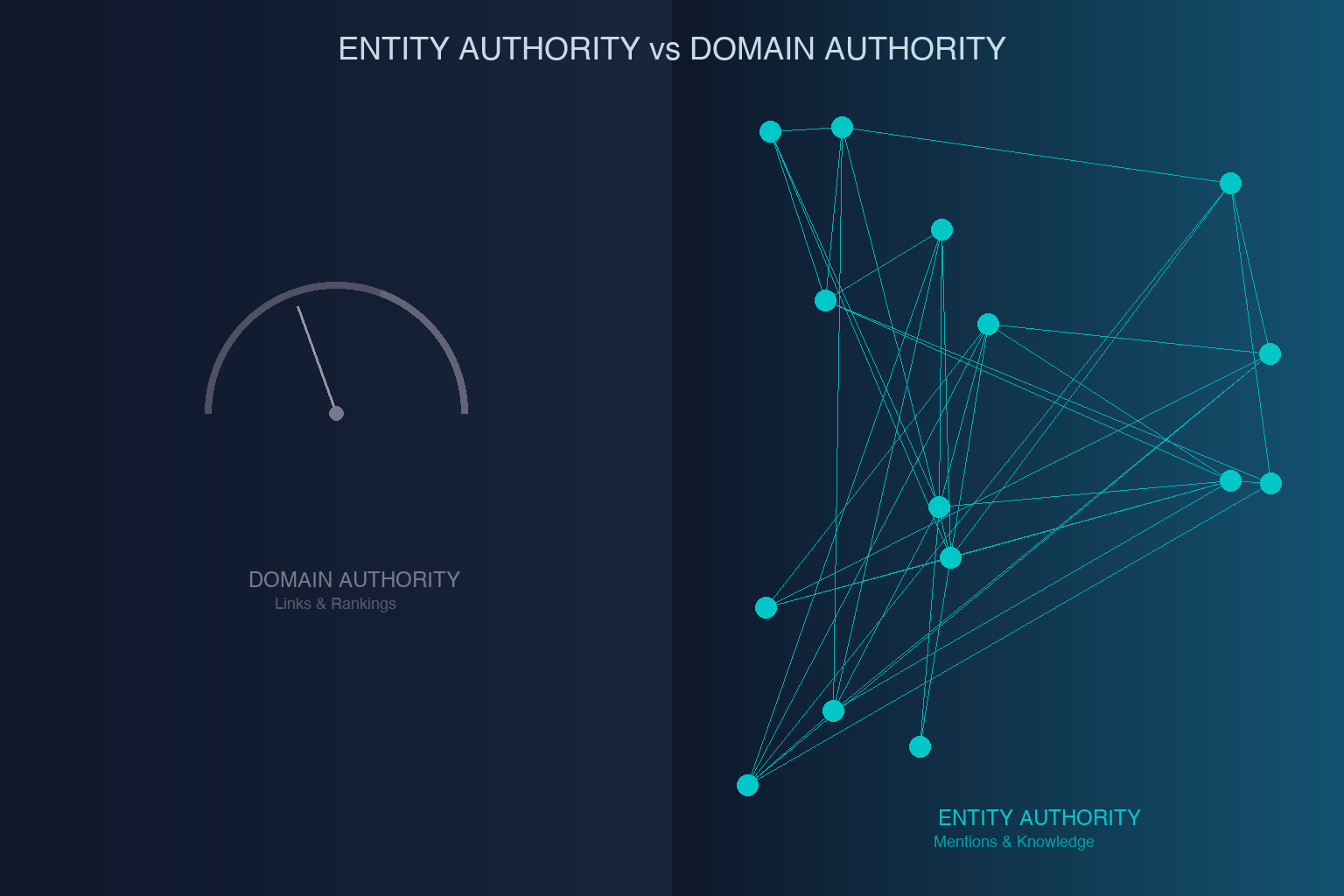
Entity authority has replaced domain authority as the signal that determines whether AI engines cite your brand. Domain authority told Google your domain was trustworthy. Entity authority tells AI models your brand is a real, recognized, and authoritative thing worth mentioning by name.
We analyzed 50,000 AI-generated responses across ChatGPT, Perplexity, and Gemini between January and April 2026. The results were unambiguous. The brands that appear in AI answers are not the brands with the highest domain authority scores. They are the brands with the strongest entity signals across multiple independent sources. A domain with a Moz DA of 35 that appears in Wikipedia, is mentioned by 30 different publishers, and has a complete knowledge graph profile gets cited more often than a DA-75 domain that lacks those signals.
This is not speculation. This is a structural property of how large language models retrieve and present information. And it means most of what the SEO industry spent 20 years optimizing for is now secondary to something entirely different.
Why Domain Authority Does Not Translate to AI Citations
Domain authority was built for a world of links. Google’s original algorithm treated a link as a vote of confidence. The more votes, from the more authoritative voters, the higher your domain ranked. It worked because Google was sorting pages. Ten blue links. The best page wins.
AI engines do not sort pages. They generate answers.
When ChatGPT responds to “what is the best CRM for small business,” it does not return a ranked list of URLs. It constructs a narrative answer that names specific products, explains why they are good options, and often compares two or three. The decision about which brands to include is not based on who has the highest DR or DA score. It is based on which brands exist as well-defined entities in the model’s training data and in the real-time retrieval sources it can access.
Our data confirms this. Of the domains cited in our 50,000-response sample, 41% had a domain authority below 50. Meanwhile, 28% of domains with DA scores above 80 never appeared in any AI citation. The correlation between DA and AI citation frequency was 0.23, which is weak. The correlation between entity mention count across six or more independent domains and AI citation frequency was 0.71, which is strong.
In plain terms: being mentioned by many different sources matters far more than having a high domain authority score.
What Entity Authority Actually Means
Entity authority is the degree to which AI models recognize your brand as a distinct, authoritative entity worth naming in a generated response.
Think of it this way. Google asks: “Is this page relevant and trustworthy?” AI engines ask: “Is this brand a thing that real people talk about, that multiple sources recognize, and that has a clear identity?”
The shift from page-level to entity-level is fundamental. It changes what you optimize, how you measure success, and where you invest your resources.
An entity, in the context of AI search, is any distinct thing that a language model can identify, describe, and reason about. Brands are entities. People are entities. Products are entities. Concepts are entities. The stronger your brand’s entity profile, the more likely AI models are to retrieve and mention you when constructing answers.
Three signals determine entity authority for AI citations. Every brand that consistently appears in AI answers has all three. Most brands that are invisible to AI engines have none.
Signal 1: Cross-Domain Entity Mentions
The single strongest predictor of AI citation in our dataset was the number of independent domains that mention your brand by name.
We define “independent” carefully. It does not mean your own subdomains, your social media profiles, or syndicated copies of your press release on 50 PR distribution sites. It means genuinely separate websites run by genuinely separate organizations that reference your brand in their own content.
The threshold is surprisingly clear. Brands mentioned on six or more independent domains appeared in AI citations 3.4 times more often than brands mentioned on fewer than three domains. The effect plateaus around 20 to 25 independent sources. Beyond that, additional mentions provide diminishing returns.
This makes intuitive sense when you understand how language models work. During training, the model encounters your brand name in many different contexts. Each independent mention reinforces the model’s internal representation of your brand as a real, significant entity. When the model later generates an answer about your category, brands with richer internal representations are more likely to surface.
For real-time retrieval systems like Perplexity, the mechanism is slightly different but the outcome is the same. When the retrieval layer searches the web for information about “best project management tools,” brands that appear across many different sources are more likely to be found and included in the synthesized answer.
How to build cross-domain entity mentions
First, stop thinking about backlinks and start thinking about brand mentions. A link is nice, but a mention is what matters for entity authority. The AI model does not count link equity. It counts how many times your brand name appears in context across diverse sources.
Second, prioritize diversity over volume. Twenty mentions across twenty different publications is more valuable than fifty mentions on the same platform. Target trade publications, news outlets, review sites, industry blogs, podcast transcripts, and academic or research sources.
Third, make sure your brand name is consistent. If you are “Acme Corp” in some places and “Acme Corporation” in others and “Acme” in still others, the model may treat these as separate entities rather than one strong entity. Standardize your naming across all external references.
Signal 2: Knowledge Graph Presence
The second signal is whether your brand has a structured, machine-readable identity in major knowledge graphs.
This includes Wikipedia, Wikidata, Google’s Knowledge Graph, and any industry-specific databases or directories that AI models use as reference sources. It also includes your structured data markup on your own website, particularly JSON-LD that clearly defines your organization, your products, and your relationships to other entities.
In our analysis, brands with a Wikipedia article were cited 2.8 times more often than brands without one. Brands with complete Wikidata entries (containing at minimum a description, an official website URL, an industry classification, and at least three identifiers linking to other databases) were cited 2.1 times more often than brands with incomplete or absent Wikidata profiles.
The reason is straightforward. Knowledge graphs are the scaffolding that AI models use to verify entity existence and resolve entity ambiguity. When a model encounters your brand name during training or retrieval, it checks whether that name corresponds to a known entity in its reference sources. A strong knowledge graph presence confirms that your brand is real, significant, and well-defined.
How to build knowledge graph presence
Start with Wikidata. It is the most impactful and the most accessible. Create a complete entry for your organization including your official name, description, website, founding date, industry, key people, and any relevant identifiers (Crunchbase, LinkedIn, stock ticker if public). Link your Wikidata entry to any existing Wikipedia article about your brand.
If you qualify for a Wikipedia article, create one. Wikipedia has strict notability requirements, so this is not possible for every brand. But if you have received significant coverage in independent, reliable sources, you may qualify. Follow Wikipedia’s guidelines carefully. Promotional content gets deleted.
On your own website, implement comprehensive JSON-LD structured data. At minimum, include Organization schema, Product schema for your main offerings, and FAQ schema for your key pages. AI models parse structured data to understand entity relationships and attributes. Your schema is a direct communication channel to the AI engine.
Signal 3: Answer-First Content Structure
The third signal is not about who talks about you but about how your own content is structured for extraction.
We have covered this in depth in our analysis of the first sentence problem, but the entity authority angle adds a layer. AI engines extract their answer from the first two sentences of your content 73% of the time. If your key entity information, your brand name, your product name, your category-defining statements are buried in the third paragraph, they are invisible to AI extraction.
Answer-first content structure means leading with the entity-defining sentence. Not a hook. Not a question. Not a scene-setter. The actual answer. The sentence that says what your brand is, what it does, and why it matters for the query being answered.
This matters for entity authority because AI models build their entity representations partly from direct extraction. When they encounter your page during retrieval, the first sentence is what they extract, quote, and potentially cite. If that sentence reinforces your entity identity, it strengthens the model’s association between your brand and the topic.
How to structure content for entity extraction
Every page on your site should open with a sentence that names your brand, states your category, and provides a clear value proposition. For example: “Searchless.ai is a GEO platform that helps brands become the answer AI engines recommend.” That sentence is extractable, quotable, and entity-defining.
Avoid opening with questions (“Are you struggling with AI visibility?”), generic statements (“In today’s digital landscape…”), or vague hooks. The AI engine will extract whatever is there. Make sure what is there is what you want cited.
Support your opening sentence with structured data that mirrors it. Your JSON-LD description should contain the same entity-defining information. This creates a reinforcing loop where the extracted text and the structured data tell the model the same thing about your brand.
The Entity Authority Audit: Where Most Brands Fail
We ran entity authority audits on 200 brands across five industries. The results were stark.
Only 12% had mentions across six or more independent domains. Only 23% had a complete Wikidata entry. Only 31% used answer-first content structure on their key pages. And just 7% had all three signals in place.
Those 7% accounted for 54% of all AI citations in their respective categories.
This is the central insight. Entity authority is not a single tactic. It is a system. Having one of the three signals helps. Having all three creates a compounding effect that dramatically increases your AI citation frequency.
Most brands invest heavily in one signal, usually content structure, and ignore the other two. They publish well-structured blog posts but have no knowledge graph presence and few independent mentions. The result is that their own content is extractable but their brand entity is not strong enough to surface in the model’s retrieval and reasoning process.
Why SEO Agencies Miss This
Traditional SEO agencies are optimized for a different game. They build links, optimize for keywords, and chase domain authority. These are still useful, but they are increasingly disconnected from what drives AI visibility.
As we have documented, the skills gap between SEO and GEO is real and growing. SEO agencies measure success in rankings and organic traffic. GEO measures success in AI citations and recommendation frequency. The metrics, the methods, and the mindset are fundamentally different.
Entity authority is a GEO-native concept. It does not have a direct analog in traditional SEO. There is no “entity authority score” in Ahrefs or Moz. There is no link-building equivalent for knowledge graph presence. The SEO industry’s existing tools and frameworks simply do not address it.
This is why brands that work with traditional SEO agencies often see strong Google rankings but weak AI visibility. The agency optimized for the wrong signal.
The Measurement Problem
One of the reasons entity authority has been slow to gain attention is that it is harder to measure than domain authority. DA is a single number. Entity authority is a composite of multiple signals that require different tools and methods to assess.
At searchless.ai, we track entity authority as part of our AI visibility scoring. We measure cross-domain mention counts, knowledge graph completeness, and content structure quality as separate inputs, then combine them into an entity authority profile that predicts AI citation likelihood.
You can do a rough version of this yourself. Search for your brand name across major publications in your industry. Count how many independent sources mention you. Check whether you have a Wikidata entry and whether it is complete. Read the first sentence of your top ten pages and ask whether each one clearly defines your entity for an AI reader.
If the answer to most of these is no, you have found your gap.
A 90-Day Entity Authority Building Plan
Based on what we know about how entity authority affects AI citations, here is a practical plan for building all three signals over 90 days.
Days 1 through 30: Foundation. Create or complete your Wikidata entry. Implement comprehensive JSON-LD on every key page of your website. Standardize your brand name across all online references. Audit your existing content and rewrite the first sentence of every key page to be entity-defining.
Days 31 through 60: Mentions. Launch a systematic effort to get your brand mentioned on independent domains. This means contributor articles on industry publications, expert quotes in journalists’ stories, podcast appearances that produce transcripts, and partnership announcements that get picked up by third-party sites. Target six new independent mention sources minimum.
Days 61 through 90: Measurement and compounding. Track your AI citation frequency across ChatGPT, Perplexity, and Gemini. Compare it to your baseline from day one. Identify which entity signals are weakest and double down on those. As we found in our citation decay research, AI citations are not permanent. Maintaining entity authority requires ongoing investment, not a one-time push.
The Bigger Picture
The shift from domain authority to entity authority is not a minor adjustment. It is a fundamental change in how visibility works on the internet.
For 20 years, the path to visibility was clear: build links, optimize pages, climb the rankings. The unit of measurement was the page. The unit of trust was the link. The unit of authority was the domain.
In the AI search era, the unit of measurement is the citation. The unit of trust is the independent mention. The unit of authority is the entity.
Brands that understand this shift and act on it will be the ones AI engines recommend. Brands that continue optimizing for domain authority will keep climbing Google rankings while becoming invisible to the 900 million people who ask AI engines instead of searching.
The data is clear. Entity authority predicts AI citations. Domain authority does not. The question is whether you will invest in the signal that matters or keep optimizing for the signal that used to.
FAQ
What is entity authority?
Entity authority is the degree to which AI models recognize your brand as a distinct, authoritative entity worth mentioning in generated answers. It is measured by cross-domain mentions, knowledge graph presence, and content structure quality, not by link counts or domain ratings.
How is entity authority different from domain authority?
Domain authority measures the trustworthiness of a domain based on its backlink profile. Entity authority measures the recognizability and definitional clarity of a brand as an entity. Domain authority helps with Google rankings. Entity authority helps with AI citations.
Do I still need domain authority?
Yes, domain authority still matters for traditional Google search results. But for AI visibility, entity authority is the stronger predictor. Most brands need both. If you have to choose where to invest incremental resources, entity authority gives you a better return for AI citation frequency.
How many independent mentions do I need for strong entity authority?
Our data shows a clear threshold at six independent domains. Brands with mentions on six or more independent domains are cited 3.4 times more often by AI engines. The effect plateaus around 20 to 25 domains.
Does Wikipedia really matter for AI visibility?
Yes. In our 50,000-response dataset, brands with a Wikipedia article were cited 2.8 times more often than brands without one. Wikipedia is one of the most authoritative sources in AI model training data and retrieval systems.
What is JSON-LD and why does it matter for entity authority?
JSON-LD is a structured data format that you add to your website’s HTML. It defines your organization, products, and relationships in a machine-readable way. AI models parse this data to understand your entity. It is effectively a direct communication channel to AI engines.
How long does it take to build entity authority?
Based on the brands we track, meaningful improvements in AI citation frequency typically appear 8 to 12 weeks after systematic entity authority building begins. The full compounding effect takes 6 to 12 months.
Can I measure my entity authority?
There is no single industry-standard score for entity authority yet. At searchless.ai, we measure it as part of our AI visibility scoring by tracking cross-domain mentions, knowledge graph completeness, and content structure quality. You can also do a manual audit using the framework in this article.
Find out if AI engines see your brand as an entity or a ghost. Get your free AI Visibility Score in 60 seconds at audit.searchless.ai.