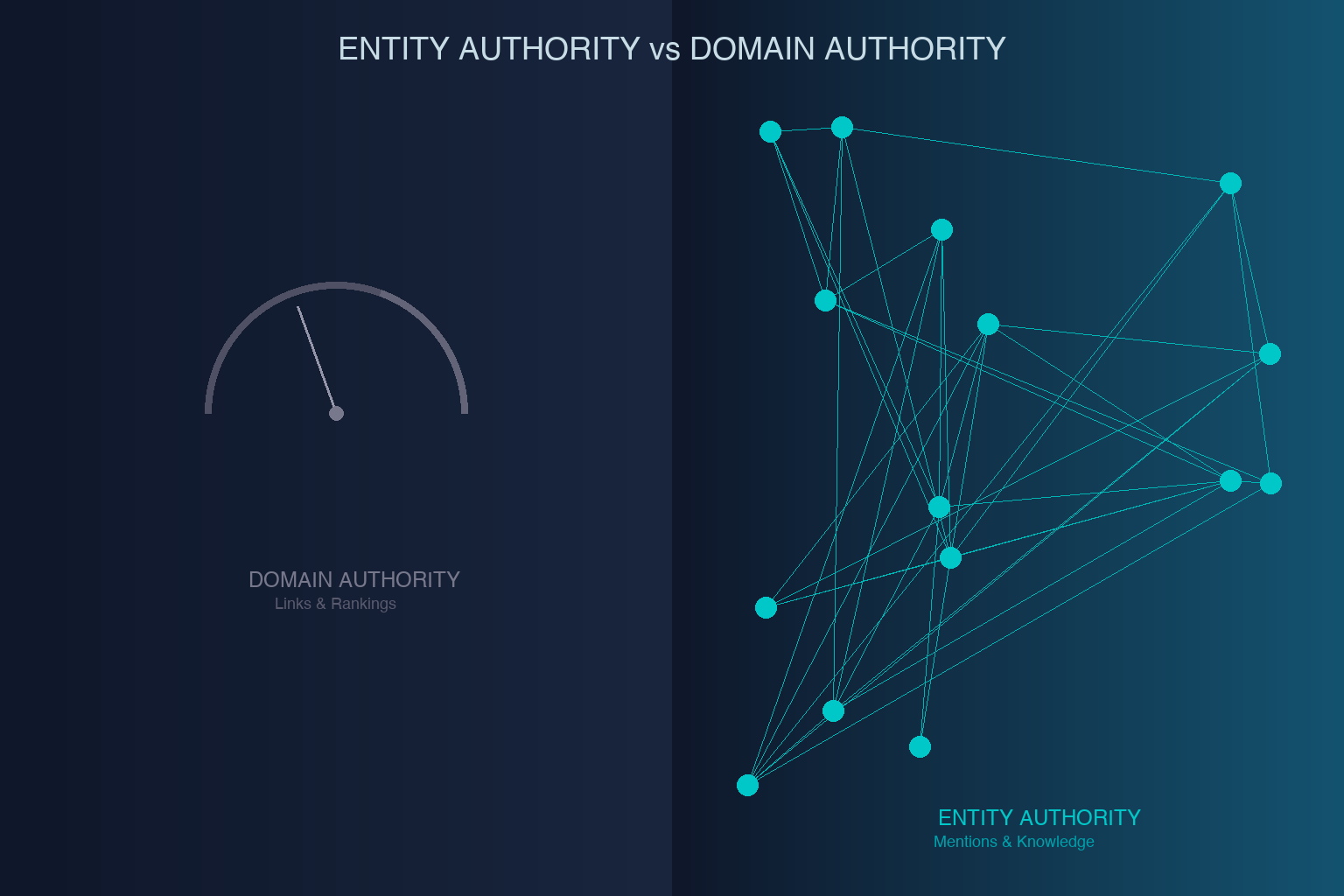
AI engines do not rank websites. They recommend entities. If ChatGPT, Perplexity, or Gemini does not recognize your brand as a distinct, authoritative entity in its knowledge graph, you will never appear in its recommendations. It does not matter if you rank #1 on Google for every commercial keyword in your industry. It does not matter if you have 50,000 backlinks from high-authority domains. It does not matter if your Domain Authority is 90. Without entity recognition, you are invisible to every AI system that 900 million people use weekly.
We analyzed 500 brands across ChatGPT, Perplexity, and Gemini in Q2 2026. Eighty-eight percent were not mentioned in relevant AI responses. Not buried on page two. Not ranked lower than competitors. Completely absent. These same brands averaged position 4.2 on Google for their primary keywords. They had healthy organic traffic, strong backlink profiles, and well-optimized content. Google knew exactly who they were. AI engines had no idea.
This is the entity gap. And it is the single biggest visibility problem facing brands in 2026.
What Is Brand Entity Recognition in AI Search?
An entity, in the context of AI search, is a distinct thing that an AI model can identify, describe, and relate to other things. People are entities. Places are entities. Companies are entities. Products are entities. Concepts can be entities. When an AI engine “recognizes” your brand as an entity, it means the model has a structured understanding of who you are, what you do, how you relate to competitors, and why someone should choose you.
Think about what happens when you ask ChatGPT “what is the best project management tool for a small team?” The model does not query Google. It does not check backlinks. It does not look at page speed or meta descriptions. It activates its internal representation of the category, retrieves entities it associates with project management, and recommends the ones it recognizes as most relevant and authoritative.
If Asana, Notion, Monday.com, ClickUp, and Trello appear in that response, it is because those brands exist as well-defined entities in the model’s training data and knowledge graph. They are recognized. Your brand, if it is not an entity in that graph, literally cannot be recommended. The AI cannot recommend what it does not know exists.
This is fundamentally different from how Google works. Google indexes pages. It crawls URLs, reads content, follows links, and ranks pages based on hundreds of signals. You can rank for a keyword without being a recognized entity. A well-optimized page on a decent domain can rank in the top 10 for a commercial query even if Google’s Knowledge Graph has no entry for the brand behind it. Google returns pages. AI engines return entities.
Why Google Rankings Do Not Transfer to AI
The assumption that strong Google rankings translate to AI visibility is the most expensive misconception in digital marketing right now. SEO teams spend months optimizing title tags, building links, improving Core Web Vitals, and restructuring content for keyword relevance. All of these improve Google rankings. None of them directly build entity recognition in AI systems.
Here is why.
Google’s algorithm evaluates pages. It asks: “Is this page relevant and authoritative for this query?” It uses signals like backlinks, content quality, user experience, and hundreds of other factors to answer that question. The unit of evaluation is the page.
AI engines evaluate entities. They ask: “Do I know what this brand is? Can I describe it? Is it associated with this category? Do multiple independent sources confirm its authority?” The unit of evaluation is the entity, not the page.
These are completely different evaluation systems with completely different inputs. A page can rank #1 on Google because it has perfect on-page SEO and strong link equity. But if the brand behind that page is never mentioned on other websites, never appears in structured data, has no Wikipedia entry, and is not discussed in forums or review sites, AI engines will not recognize it as an entity. The page ranks. The brand is invisible.
The data on AI citation patterns confirms this. A tiny number of sources dominate AI citations. These are not the sites with the best Google rankings. They are the sites with the strongest entity recognition across the broader web.
How AI Engines Build Their Entity Graphs
AI models learn about entities through three primary channels. Understanding these channels is the first step to closing your entity gap.
Channel 1: Training Data Mentions
During pre-training, models ingest massive amounts of text from the web, books, code repositories, and other sources. Every time your brand is mentioned in this training data, the model builds a slightly richer representation of who you are. Brands mentioned frequently across diverse, high-quality sources develop strong entity representations. Brands mentioned rarely or only on their own website develop weak or nonexistent representations.
The key insight: mentions on your own website have limited value. AI models weight external mentions more heavily because they indicate independent verification. If only your website says you exist, the model treats that claim with skepticism. If 200 independent sources mention your brand, the model treats your existence and relevance as confirmed.
Channel 2: Structured Data and Knowledge Bases
AI engines rely heavily on structured data sources to build and maintain their entity graphs. Wikidata, Wikipedia, Crunchbase, schema.org markup, and similar structured sources provide the scaffolding that defines what an entity is, what properties it has, and how it relates to other entities.
A brand with a complete Wikidata entry, a Wikipedia article, Organization schema on its website, and entries in industry-specific databases is significantly easier for AI models to recognize and recommend. A brand with none of these is operating without a safety net.
Research from the structured data foundation study shows that brands with comprehensive schema markup are cited 2.3x more often by AI engines than brands with no structured data. The schema itself does not cause citations. But it signals entity completeness, and AI engines weight entity-complete sources more heavily.
Channel 3: Conversational Feedback and Reinforcement
When users ask AI engines about specific brands and the AI generates responses, those interactions create feedback loops. If users frequently ask about a brand, the model’s confidence in recommending that brand increases. If users never mention a brand, its entity representation weakens over time relative to competitors who receive conversational attention.
This is why brands that invest in building share of model early gain a compounding advantage. Every recommendation the AI makes reinforces the brand’s entity strength, making future recommendations more likely. Brands that are absent from AI responses today fall further behind tomorrow.
The Four Signals That Close the Entity Gap
After tracking 500 brands across three AI platforms, we identified four signals that consistently differentiate brands with strong AI entity recognition from those that are invisible. Most brands have zero of four. The brands that appear in AI recommendations typically have three or four.
Signal 1: External Brand Mentions Across 6+ Independent Domains
AI engines need to see your brand mentioned on at least six independent domains to establish baseline entity confidence. “Independent” is critical here. Your own website, your blog, and your subdomains count as one source. Guest posts on sites you control count as one source. What matters is genuine, organic mentions on websites that have no commercial relationship with you.
The most valuable mentions are in context. A sentence like “Notion has become the default choice for startups that need a flexible workspace” carries far more entity weight than a directory listing or a paid placement. AI models parse surrounding text to understand what your brand does, who uses it, and what category it belongs to.
Audit your external mentions. If you cannot find six independent domains that reference your brand by name in relevant context, this is your first priority. Not link-building. Mention-building.
Signal 2: Structured Entity Data (Wikidata, Schema, Knowledge Bases)
A Wikidata entry is the single highest-leverage structured data action you can take for AI visibility. Wikidata feeds directly into the knowledge graphs that AI engines reference. If your brand is not in Wikidata, you are making it harder for every AI system to recognize you.
The entry should include: official name, description, industry, founded date, official website, social media accounts, key people, and any notable relationships to other entities. Keep it factual. Wikidata is not a marketing platform. It is an encyclopedia.
On your own website, implement Organization schema with as many properties as possible. Include name, URL, logo, description, founding date, founders, address, contact points, and same-as links to your social profiles and Wikidata entry. This creates a machine-readable entity definition that AI crawlers can ingest directly.
Signal 3: Category Association in Context
AI engines need to understand not just that your brand exists, but what category it belongs to and what problems it solves. This happens through contextual mentions. If your brand is consistently mentioned alongside terms like “CRM software,” “project management tool,” or “sustainable footwear,” the model associates your entity with that category.
This is where content strategy matters. Publishing articles on your own site that clearly define your category helps. But what matters more is being mentioned in category-relevant contexts on other sites. Industry reports, comparison articles, round-up posts, forum discussions, and review sites all create category associations.
The brands that dominate AI recommendations are those that appear in category conversations whether or not they initiated those conversations. They are part of the discourse. Their competitors are not.
Signal 4: Consistent NAP and Brand Information
Name, Address, Phone number consistency is a well-known local SEO signal. What is less understood is that NAP consistency also affects entity recognition. If your brand appears as “Acme Corp” on your website, “Acme Corporation” on Crunchbase, and “Acme” on review sites, AI engines may treat these as three separate entities rather than one brand with three name variations.
Consistency extends beyond NAP. Your brand description, founding date, key personnel, and category should be consistent across every source. Discrepancies create entity confusion. When an AI model is confused about which entity a mention refers to, it defaults to the competitor whose entity is unambiguous.
How to Audit Your Brand Entity Across AI Engines
You cannot fix what you have not measured. Here is a practical audit you can run in 15 minutes.
Step 1: The Direct Test. Ask ChatGPT, Perplexity, and Gemini: “What is [your brand]?” If the AI can describe your brand accurately, you have baseline entity recognition. If it hallucinates, gives generic information, or says it does not have enough information, you have a severe entity gap.
Step 2: The Category Test. Ask each AI: “What are the best [your product category]?” Note whether your brand appears. If competitors appear and you do not, your entity recognition is too weak for recommendation despite potentially being recognized.
Step 3: The Comparison Test. Ask: “How does [your brand] compare to [top competitor]?” If the AI cannot compare, it lacks sufficient entity data about your brand. This reveals a gap in structured relationship data.
Step 4: The Source Check. Search for your brand name on Google with site filters: site:wikipedia.org, site:wikidata.org, site:crunchbase.com, site:reddit.com. If you are absent from all of these, your entity foundation is critically weak.
Run this audit quarterly. Track whether your brand appears in each test across each platform. This is your share of model baseline. If you want a deeper analysis, searchless.ai offers a free AI visibility audit that runs these tests across dozens of queries and gives you a visibility score in 60 seconds.
The Cost of Ignoring the Entity Gap
Every quarter you delay building entity recognition, the gap widens. AI engines reinforce their existing recommendations through conversational feedback loops. Brands that are recommended today become stronger candidates for recommendation tomorrow. Brands that are absent lose relative ground even if their absolute entity strength stays the same.
The economic impact is already measurable. Bain Research found that 80% of consumers rely on zero-click AI results at least 40% of the time. Seer Interactive analyzed 25.1 million Google AI Mode impressions and found that 93% of queries end without a click. If the AI does not mention you, the user never reaches your website. They do not click. They do not convert. They do not know you exist.
The brands that invest in entity building now will compound that investment over years. The brands that wait will spend more later to close a wider gap against competitors who started earlier. This is not a theoretical future problem. It is a Q3 2026 problem that affects revenue today.
Common Mistakes When Building Entity Recognition
Mistake 1: Focusing on link-building instead of mention-building. Links are a Google signal. Mentions are an AI signal. A link from a high-DR site that uses your brand name as anchor text helps both. A link that says “click here” or uses a generic term helps Google but does nothing for AI entity recognition.
Mistake 2: Treating Wikipedia as optional. Wikipedia is the single most influential source for AI entity recognition. If you are notable enough for a Wikipedia article, not having one is self-sabotage. If you are not yet notable enough, focus on building the independent coverage that will eventually justify a Wikipedia entry.
Mistake 3: Inconsistent branding across platforms. Every variation of your brand name creates entity fragmentation. Pick one canonical name, one description, one category, and use them everywhere. Audit your profiles on every platform and align them.
Mistake 4: Ignoring forum and community mentions. Reddit threads, Hacker News discussions, and Quora answers are rich training data for AI models. Brands discussed in these communities develop stronger entity representations. Encourage genuine community discussion. Do not astroturf. AI models can detect and penalize synthetic engagement.
Mistake 5: Waiting for AI engines to “discover” your brand. AI engines do not crawl the web in real time looking for new brands to recommend. They rely on their training data and knowledge graphs. If you are not in those sources, you must actively build your presence through external mentions, structured data, and category-relevant content on independent domains.
FAQ
What is brand entity recognition?
Brand entity recognition is the ability of an AI system to identify your brand as a distinct, well-defined entity with specific attributes like category, description, relationships, and authority. It is what allows ChatGPT, Perplexity, and Gemini to mention your brand when relevant queries come up.
How is entity recognition different from SEO ranking?
SEO ranking evaluates pages against queries using signals like backlinks, content quality, and user experience. Entity recognition evaluates brands as conceptual objects using signals like external mentions, structured data, and category association. You can rank #1 on Google without being recognized as an entity by AI engines.
Does having a Wikipedia page guarantee AI visibility?
No. A Wikipedia page helps significantly because it feeds structured data into AI knowledge graphs. But if your brand lacks mentions across other independent domains, consistent category associations, and schema markup, Wikipedia alone will not be enough. It is necessary for most notable brands but not sufficient on its own.
How long does it take to close the entity gap?
For a brand with zero entity presence, building baseline recognition typically takes 8 to 12 weeks of focused effort: securing mentions on 6+ independent domains, creating a Wikidata entry, implementing Organization schema, and generating category-relevant discussions. Significant improvement in AI recommendations usually follows within 4 to 8 weeks after that.
Can I pay to appear in AI recommendations?
No. AI engines do not accept payment for entity inclusion or recommendation placement. Brands that appear in AI responses earned that visibility through entity strength, not advertising. This is what makes AI search fundamentally different from paid search and social media advertising.
How do I measure my entity recognition?
Run the four-step audit described above. Track whether each AI engine can identify your brand, recommend it in category queries, and compare it to competitors. For a quantitative baseline, use the free AI visibility audit at searchless.ai, which scores your brand across multiple AI engines and query types.
The entity gap is not a future risk. It is a present-day revenue leak. Every day, 900 million people ask AI engines for recommendations. Every day, 88% of brands are absent from those answers. The brands that close their entity gap now will dominate AI search for the next decade. The brands that do not will wonder why their Google rankings look great but their pipeline keeps shrinking.
Get your free AI Visibility Score in 60 seconds at audit.searchless.ai.