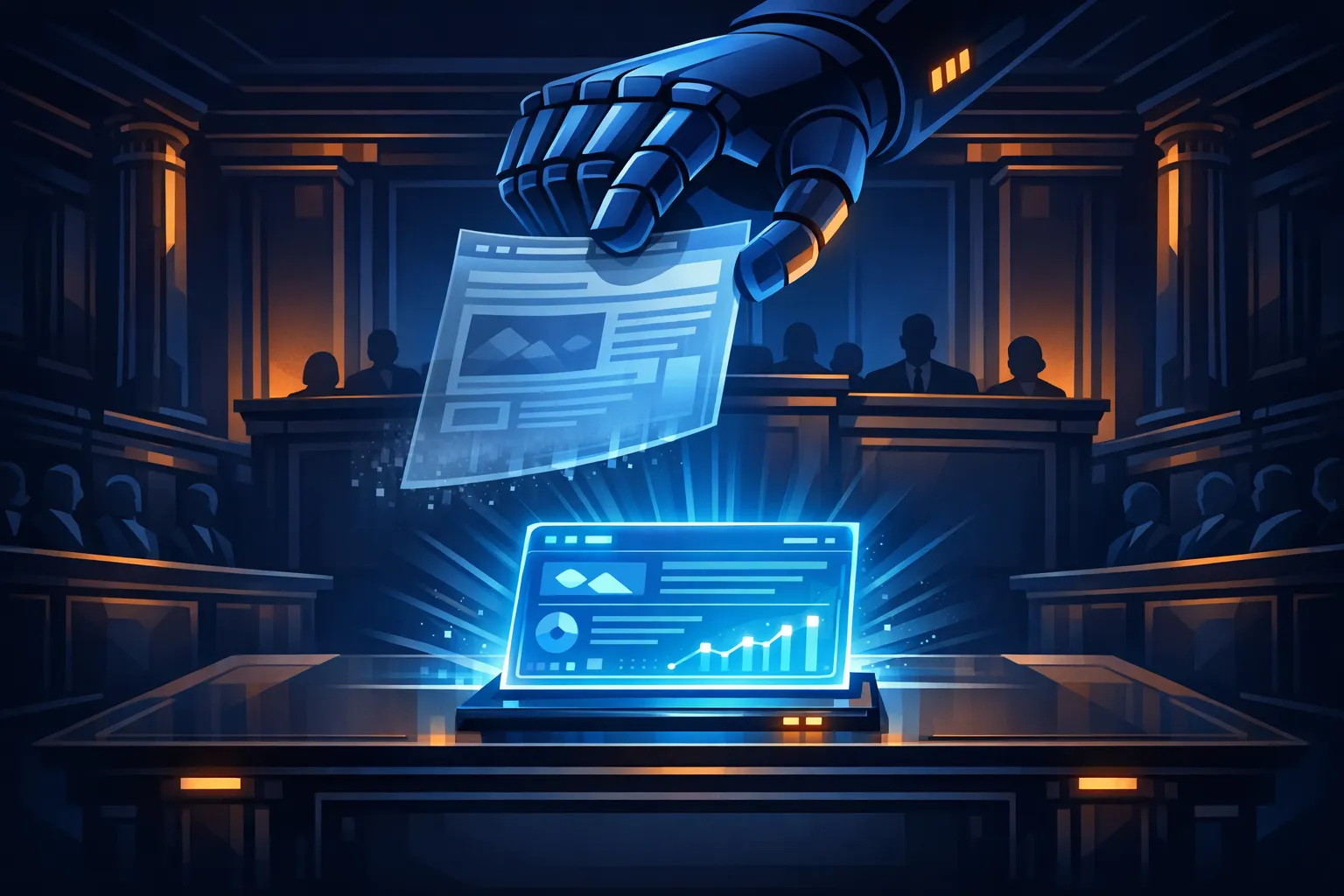
Google filed a patent in 2026 that describes technology capable of replacing your website landing page entirely with AI-generated content. Not summarizing it. Not featuring it in a snippet. Replacing the need for a user to visit your page at all, and potentially rewriting what they see to better fit the query. If this technology ships, it would represent the single largest disruption to web-based commerce since Google AdWords launched in 2000.
This is not speculation about a future that might never arrive. The patent language is specific. The technical architecture is detailed. And Google has already demonstrated the building blocks through AI Overviews, AI Mode, and the Android search bar integration that pushed AI answers to 3 billion devices in April 2026. The trajectory is clear. The question is timing.
What the Patent Actually Says
The Wikipedia entry for AI Overviews, updated with references to the 2026 patent filing, describes a system where Google’s AI does not merely extract and display excerpts from web pages. Instead, the system can generate entirely new content that synthesizes information from multiple sources and presents it as the answer to a user’s query, effectively making the original landing page redundant.
Here is why this matters in plain terms. When someone searches “best project management software for small teams” today, Google AI Overviews already generates a synthesized answer that cites multiple sources. The user often does not click through to any of them. The patent takes this further: it describes a system where the AI-generated response could include purchase links, feature comparisons, pricing data, and recommendation logic that was previously only available by visiting the brand’s own website.
In other words, Google is building the infrastructure to make your landing page a backend data source rather than a customer-facing asset. The AI becomes the front door. Your website becomes the warehouse.
The Numbers That Make This Inevitable
This patent did not appear in a vacuum. Google has been moving toward this outcome for years, and the 2026 data tells the story clearly.
| Metric | Value | Source |
|---|---|---|
| Zero-click rate on traditional Google search | 25-30% | SparkToro/Datos 2025 |
| Zero-click rate on Google AI Overviews | ~43% | Position.digital 2026 |
| Zero-click rate on Google AI Mode | ~93% | Position.digital 2026 |
| Android devices with AI Mode in search bar | 3 billion | Google April 2026 |
| Weekly AI engine users globally | 900 million | Multiple sources |
| Google AI Overviews coverage | 80%+ of informational queries | SEJ 2026 |
The pattern is unambiguous. Each step Google takes toward AI-generated answers increases the zero-click rate. AI Overviews tripled it. AI Mode tripled it again. If the patent’s technology ships, the zero-click rate for commercial and transactional queries could reach the same 90%+ range that informational queries already see.
Google has economic incentives to pursue this aggressively. Every click that stays on Google’s property is an ad impression they control. Every AI-generated landing page is a surface they can monetize. Publishers and brands lose the visit. Google keeps the attention.
Why This Is Different From Previous Zero-Click Concerns
SEO professionals have been worrying about zero-click search since at least 2020, when the SparkToro study first quantified it at around 50% of all Google searches. But there is a critical difference between then and now.
In 2020, zero-click meant the user found the answer on Google’s page without clicking through. The answer still came from a website. Google displayed your snippet, your structured data, your Knowledge Panel. Your brand was visible even if the user did not click.
The 2026 patent describes something fundamentally different. The AI does not display your content. It generates its own content using your content as raw material. The user sees Google’s AI answer, not your page. Your brand might not be mentioned at all, even though your data informed the response.
This is the shift from “zero-click but visible” to “zero-click and invisible.” It is the difference between someone reading a billboard with your company name on it and someone getting a personalized recommendation that happens to use your pricing data without crediting you.
What This Means for Different Business Models
The impact of AI-replaced landing pages will not be evenly distributed. Here is how it hits different types of businesses.
E-commerce and Product Pages
Product landing pages are prime targets for AI replacement. If Google’s AI can synthesize product specs, pricing, reviews, and availability from structured data feeds, it can present a complete buying recommendation without the user ever seeing your product page. The AI becomes the product page.
This is already happening in travel. Booking.com integrated directly into ChatGPT in early 2026, allowing users to complete hotel reservations inside the AI interface without ever visiting a hotel website. The hotel pays the commission. The hotel loses the direct relationship. Google’s patent extends this logic to every product category.
SaaS and B2B
SaaS comparison pages, feature lists, and pricing pages are similarly vulnerable. When someone asks Google “what is the best project management tool for remote teams,” the AI can generate a comparison table using data from ten different SaaS websites without linking to any of them. The user makes a decision inside Google’s interface.
This is already the reality. Ahrefs reported in April 2026 that AI engines like ChatGPT frequently retrieve data from one source but cite a different one. Your carefully crafted comparison page could inform the AI’s recommendation while the credit goes to a competitor.
Content Publishers and Media
Publishers face the most immediate threat. AI Overviews already summarize articles without requiring a click-through. The patent describes extending this to generate entire articles that synthesize multiple sources. Why visit a news site when Google’s AI can write a better, more comprehensive article in real time using data from a dozen publications?
The Stanford AI Index 2026, a 400+ page report released in April, flagged that generative AI reliability gaps are narrowing while adoption outpaces every previous technology shift, including the internet itself. The quality of AI-generated content is getting closer to human-written content every quarter. For publishers, the window to adapt is closing.
Local Businesses
Local businesses are somewhat insulated because physical presence creates a verification layer that AI cannot easily replicate. Google still needs your address, your hours, your photos, your reviews. But even here, the patent’s logic applies: if Google’s AI can answer “best Italian restaurant near me” with a synthesized recommendation that includes pricing, ambiance descriptions, and menu highlights scraped from multiple sources, the user has less reason to visit your Google Business Profile or your website.
Defensive Strategies: What Brands Should Do Now
The patent has not shipped yet. Google files thousands of patents that never become products. But the direction is unmistakable, and the intermediate steps (AI Overviews, AI Mode, Android integration) are already live. Brands that wait for the patent to ship before adapting will be years behind.
Here are the defensive strategies that matter most, ranked by urgency.
1. Build Entity Authority Across Multiple Platforms
AI engines do not just read your website. They read the entire web. If your brand is mentioned consistently across Reddit, industry publications, review sites, podcasts, and social media, the AI has multiple corroborating signals that your brand is legitimate and authoritative. This makes it harder for the AI to omit you or misattribute your data.
The 5WPR AI Citation Source Index, released May 1, 2026, found that Reddit alone captures roughly 40% of all AI citations. Brands with active Reddit presence are dramatically more likely to appear in AI answers. Community platforms, forums, and third-party review sites are not optional extras anymore. They are primary AI citation sources.
2. Structure Your Content for Machine Extraction
AI engines read structured data far more reliably than unstructured prose. JSON-LD schema markup, FAQ schemas, product schemas, and organizational schemas give AI engines clean, parseable signals about your brand, your products, and your expertise.
The research from BeyondBooking on hotel GEO in 2026 found that businesses with comprehensive schema markup were cited correctly by AI engines significantly more often than those without it. Schema does not just help Google understand your page. It helps every AI engine on the internet extract accurate information about your brand.
llms.txt is the other structural signal. It tells AI engines how to read your site, what content is available, and how to access it. As of early 2026, roughly 95% of websites do not have one. Having llms.txt is a fast, free advantage.
3. Publish Original Data and Research
AI engines prioritize sources that provide unique information, not sources that republish what everyone else is saying. If your brand produces original research, proprietary data, unique analysis, or primary source material, you become harder to replace because the AI needs your data to generate a good answer.
This is the “citation moat” strategy. Make your content the kind of thing AI engines must cite because they cannot generate the same insight from generic web data. Surveys, benchmarks, proprietary datasets, expert interviews, and original experiments all qualify.
4. Monitor Your AI Visibility Actively
You cannot defend a position you do not know you hold. Most brands have no idea whether AI engines mention them, misattribute their data, or omit them entirely. Weekly prompt tracking, where you test a set of representative queries across ChatGPT, Perplexity, Gemini, and Google AI Overviews, reveals your actual AI visibility.
The HubSpot Spring 2026 Spotlight release introduced AEO tracking features for this exact reason. Their data shows that brands appearing in AI answers capture higher-quality leads that convert faster. The market is moving toward AI visibility as a core metric, not a nice-to-have.
5. Diversify Traffic Sources Beyond Google Search
If Google can replace your landing page, you need traffic sources that do not depend on Google. Email lists, community platforms, direct traffic, social media, podcast appearances, and strategic partnerships all create channels that bypass the AI answer layer. Brands with diversified traffic profiles will weather the landing page replacement far better than those dependent on Google for 60-80% of their visitors.
The AI Visibility Audit: Where You Stand Right Now
Before you can execute any of these strategies, you need to know your starting position. How often do AI engines mention your brand? When they do, do they describe you accurately? Are they citing you or a competitor using your data?
Searchless.ai offers a free AI Visibility Score that tests your brand across multiple AI engines and returns a score in under 60 seconds. It answers the most basic question every brand should be asking in 2026: does AI recommend me?
You can check your score at audit.searchless.ai.
What the Next 12 Months Look Like
Google I/O 2026 is scheduled for May 19-20. Expect Gemini updates, AI Mode expansions, and likely announcements about deeper AI integration into commercial search experiences. The patent describes the destination. Google I/O will likely reveal the next steps toward it.
For brands tracking AI search developments, the Musk v. Altman trial is also relevant. The first week of testimony concluded May 2 in Oakland, with Musk testifying for over seven hours. The trial’s outcome could reshape the competitive landscape of AI search. If OpenAI is forced to restructure, the AI search market could fragment, giving brands more surfaces to optimize for but also more complexity to manage.
The timeline is approximate, but the direction is clear. Landing pages as the primary customer-facing asset are entering their sunset phase. AI-generated answers are becoming the new front door for commercial intent. Brands that build citation moats, entity authority, and diversified traffic sources now will own visibility in the next era. Brands that keep optimizing for click-through rates will find themselves optimizing for a metric that no longer matters.
FAQ
What does the Google patent about replacing landing pages actually do?
The patent describes a system where Google’s AI generates complete responses to user queries by synthesizing information from multiple websites, potentially including purchase links, feature comparisons, and recommendations. This could make the original landing pages redundant for users, as the AI provides all the information they need without requiring a site visit.
Is Google already replacing landing pages?
Not yet at the scale the patent describes. AI Overviews summarize content and AI Mode generates comprehensive answers with a 93% zero-click rate, but the full landing page replacement technology described in the patent has not shipped. The building blocks are live. The full system is not.
Which types of businesses are most at risk from AI replacing landing pages?
E-commerce product pages, SaaS comparison and pricing pages, and content publishing sites face the highest risk. Local businesses with physical presence have more insulation. Any business whose primary customer acquisition channel is Google organic traffic should treat this as a strategic threat.
What is a citation moat and how do I build one?
A citation moat is a content strategy where you produce original data, research, and primary source material that AI engines must cite because they cannot generate the same insight from generic web data. Surveys, benchmarks, proprietary datasets, and expert interviews all contribute. The goal is to become indispensable to the AI’s answer quality.
How do I check if AI engines mention my brand?
You can run weekly manual checks by testing representative queries in ChatGPT, Perplexity, Gemini, and Google AI Overviews. For a faster and more comprehensive assessment, Searchless.ai provides a free AI Visibility Score at audit.searchless.ai that tests your brand across multiple engines and returns results in under 60 seconds.
Will Google still need websites if this patent ships?
Yes, but the relationship changes. Websites become data sources that feed Google’s AI rather than destinations that users visit directly. The content still matters because the AI needs raw material. But the traffic, the brand exposure, and the customer relationship shift toward the AI interface. Your website becomes the backend. Google’s AI becomes the frontend.
What is the difference between AI Overviews and the landing page replacement patent?
AI Overviews summarize existing web content and display it in a snippet above search results. Users can still click through to the source. The patent describes generating entirely new content that replaces the need for the source page, potentially including transactional features like purchase buttons that bypass the original website entirely.
Is AI recommending your brand or your competitor? Get your free AI Visibility Score at audit.searchless.ai and find out in 60 seconds.