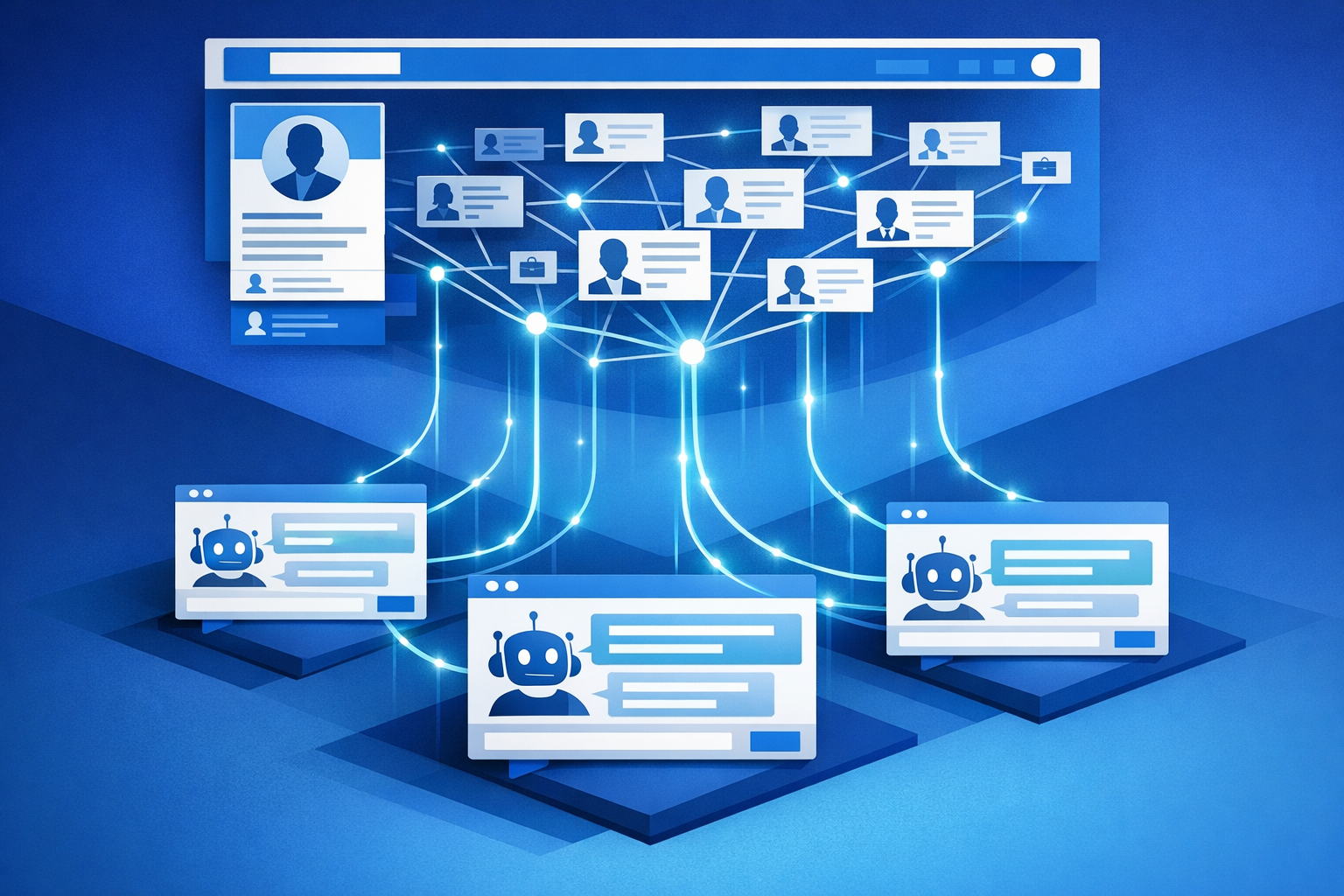
LinkedIn is now the second most cited domain across all major AI search engines, appearing in 11% of AI-generated responses on average across ChatGPT Search, Perplexity, and Google AI Mode. That puts it ahead of Wikipedia, YouTube, and every major news publisher. If your brand publishes on LinkedIn, you are already in the AI citation pipeline whether you know it or not. The question is whether AI models cite you or your competitor.
This is not speculation. Semrush analyzed 325,000 prompts and identified 89,000 unique LinkedIn URLs cited by AI search engines in January and February 2026. A separate analysis from Peec AI examined 30 million sources across five AI platforms and confirmed the same pattern: LinkedIn ranks in the top three cited domains for AI search, behind only Reddit and YouTube. And for professional and B2B queries specifically, LinkedIn is number one.
Most marketing teams still treat LinkedIn as a social channel. They should be treating it as the most important AI visibility asset they own outside their website.
The Data: How Often AI Cites LinkedIn
Multiple studies converged on the same conclusion in early 2026. Here are the hard numbers:
ChatGPT Search cites LinkedIn in 14.3% of responses, the highest rate among all AI platforms studied (Semrush, 2026).
Google AI Mode cites LinkedIn in 13.5% of responses.
Perplexity cites LinkedIn in 5.3% of responses, lower but still significant, and Perplexity leans heavily on LinkedIn for B2B queries (Peec AI, 2026).
The average across all platforms is 11%. That means roughly one in nine AI answers references LinkedIn content. For B2B topics in technology, business services, finance, and industrial sectors, the rate is even higher.
A separate study from Profound, drawing on 1.4 million citations across six AI models from November 2025 through February 2026, found LinkedIn to be the most cited domain for professional queries across all AI search platforms.
Perhaps most striking: ChatGPT cites LinkedIn 4.2 times more than it did a year ago, and Perplexity cites it 5.7 times more, according to data from Spotlight reported by Social Media Today. The growth curve is steep and accelerating.
Why AI Models Trust LinkedIn
AI search engines prioritize two signals above all else: perceived authority and authentic user input. LinkedIn delivers both in a single package.
Reddit leads overall citations because it captures real user discussions. YouTube dominates video citations through transcripts. Wikipedia serves as both a live source and a training dataset cornerstone. LinkedIn occupies a unique position: it combines professional authority signals (verified identities, company affiliations, job titles) with original, topical content.
This matters because AI models weight source credibility. A LinkedIn post from a verified professional with 2,000+ followers and a consistent posting history carries more algorithmic trust than an anonymous Reddit thread or a random blog post. The platform’s identity layer acts as a built-in authority signal that no other social platform matches at scale.
There is also a structural advantage. LinkedIn’s data partnership with Microsoft, which also operates the underlying infrastructure for Copilot and has a deep integration with OpenAI, means LinkedIn content is readily accessible to the models that power ChatGPT, Copilot, and related systems. Whether this creates a preferential citation pathway is debatable, but the data accessibility is not.
What Content Gets Cited: The 89,000 URL Breakdown
The Semrush study provides the most granular look at what makes LinkedIn content cite-worthy. Three patterns emerge:
1. Original, educational content dominates. Long-form articles (500 to 2,000 words) and mid-length posts (50 to 299 words) account for the largest share of AI citations. Between 54% and 64% of cited posts focus on sharing knowledge or practical advice. Reshares and reposts are rarely referenced.
2. Consistency beats virality. Most cited posts have moderate engagement: 15 to 25 reactions. The key signal is frequency. About 75% of cited authors post five or more times in a four-week period. Nearly half have over 2,000 followers. The models are not chasing viral posts. They are rewarding consistent, credible publishers.
3. AI echoes what it cites. Semantic similarity scores between LinkedIn content and AI responses range from 0.57 to 0.60, significantly higher than Reddit (0.53 to 0.54) or Quora (0.435). This means when AI cites your LinkedIn content, it does not just link to it. It paraphrases it closely. Your words become the answer.
This is the core insight that most brands miss: LinkedIn does not just give you a citation. It gives you narrative control over how AI describes your category, your product, and your brand.
Company Pages vs. Individual Creators: Different Platforms, Different Rules
One of the most actionable findings from the Semrush data is that different AI models prefer different LinkedIn content sources:
- Perplexity cites Company Pages 59% of the time
- ChatGPT Search cites individual creators 59% of the time
- Google AI Mode cites individual creators most often as well
This means a complete LinkedIn AI visibility strategy requires both. Your company page needs a steady stream of educational articles and authoritative content for Perplexity. Your executives, founders, and subject matter experts need to publish thought leadership posts under their own profiles for ChatGPT and Google AI Mode.
Most brands do one or the other. Doing both is the unlock.
The Geographic Strategy: Why We Call It That
The title of this article references a “geographic strategy,” and here is why that word matters. AI citation patterns are not uniform. They vary by platform, by query type, by industry, and by region. Treating LinkedIn as a single channel is like treating Europe as a single market. Technically true, strategically lazy.
Different AI platforms pull from different parts of LinkedIn. Different industries see different citation rates. Different content formats perform differently on each model. A B2B SaaS company optimizing for Perplexity citations needs a fundamentally different LinkedIn content mix than a consulting firm optimizing for ChatGPT recommendations.
At Searchless, we track these patterns across all major AI platforms and map them to specific content strategies. The brands that win AI visibility are not the ones posting the most. They are the ones posting the right content on the right platform at the right cadence. Data from the Searchless AI Visibility Score shows that brands with structured LinkedIn publishing programs see 3x higher AI citation rates than those with ad hoc social strategies.
How to Optimize Your LinkedIn for AI Citations
Based on the data, here is a practical framework:
1. Publish Original Content Weekly
The minimum viable cadence is one original long-form article per week plus two to three shorter posts (50 to 300 words). All content should be educational, not promotional. AI models ignore sales pitches. They cite explanations.
2. Lead with the Answer
AI models extract the first two sentences of content 73% of the time, according to prior Searchless research on what content gets cited by AI. Your first sentence should state the key insight directly. Do not bury the lede.
3. Use Consistent Terminology
Because AI paraphrases LinkedIn content with high semantic fidelity (0.57 to 0.60 similarity), the terminology you use matters. Define your category terms explicitly. Use the same phrasing consistently. If you call your product category “GEO” in one post and “AI SEO” in another, AI models will split the signal.
4. Build Author Authority
Cited authors tend to have 2,000+ followers and post 5+ times per month. Invest in building the profiles of your key people, not just the company page. Individual thought leadership is the primary citation source for ChatGPT and Google AI Mode.
5. Target the Right Format for Each Platform
For Perplexity: prioritize company page articles, 500 to 2,000 words, structured with clear headings. For ChatGPT: prioritize individual creator posts, 50 to 300 words, answer-first format. For Google AI Mode: a mix of both.
6. Avoid These Common Mistakes
- Resharing without adding original commentary (rarely cited)
- Posting purely promotional content (AI models filter this out)
- Inconsistent terminology across posts
- Publishing under anonymous or low-authority accounts
- Ignoring your company page in favor of only individual posts
The Broader AI Visibility Picture
LinkedIn is a critical piece of the AI citation puzzle, but it is not the only one. Our analysis at Searchless consistently shows that brands need visibility across multiple citation sources: Reddit for user discussions, YouTube for video content, their own websites for foundational authority, and LinkedIn for professional credibility.
The brands that dominate AI search results do not just publish on one platform. They create a network of authoritative content that AI models can draw from. LinkedIn is the professional node in that network, and right now, it is the node most brands are underinvesting in.
The data is clear: LinkedIn citation frequency has grown 4x to 5x in the past year. It is the number one cited source for professional queries. Its content is echoed more faithfully by AI than any other social platform. And most brands have no idea this is happening.
Your buyers are asking AI tools for recommendations right now. LinkedIn content is shaping those answers. The only question is whether it is your content or your competitor’s.
FAQ
How often does ChatGPT cite LinkedIn? ChatGPT Search cites LinkedIn in 14.3% of responses, the highest rate among all AI platforms studied in the Semrush analysis of 325,000 prompts. It cites LinkedIn 4.2 times more than it did one year ago.
Does Perplexity cite LinkedIn? Yes. Perplexity cites LinkedIn in 5.3% of responses overall, but the rate increases significantly for B2B and professional queries. Perplexity favors Company Pages over individual posts.
What kind of LinkedIn content gets cited by AI? Educational, original content. Long-form articles (500 to 2,000 words) and mid-length posts (50 to 299 words) dominate citations. Reshares and promotional posts are rarely cited. Content that leads with a clear answer in the first sentence performs best.
Is LinkedIn more cited than Wikipedia in AI search? Yes, in professional and B2B queries. Across all query types, LinkedIn ranks second or third in overall citation volume depending on the study, but for professional topics specifically, it is number one, ahead of Wikipedia, YouTube, and Reddit.
How do I track if AI cites my LinkedIn content? Tools like Searchless track AI citation patterns across ChatGPT, Perplexity, Gemini, and Google AI Mode. You can get a free AI Visibility Score at audit.searchless.ai to see how often AI recommends your brand.
Does follower count matter for AI citations? Yes. Nearly half of cited LinkedIn authors have over 2,000 followers. However, consistency matters more than raw follower numbers. 75% of cited authors post five or more times per month.
Should I post on my company page or my personal LinkedIn? Both. Perplexity favors company pages (59% of its LinkedIn citations). ChatGPT and Google AI Mode favor individual creators (59%). A complete strategy uses both.
Check your AI visibility for free. Get your Searchless Score in 60 seconds at audit.searchless.ai and see what ChatGPT, Perplexity, and Gemini actually say about your brand.