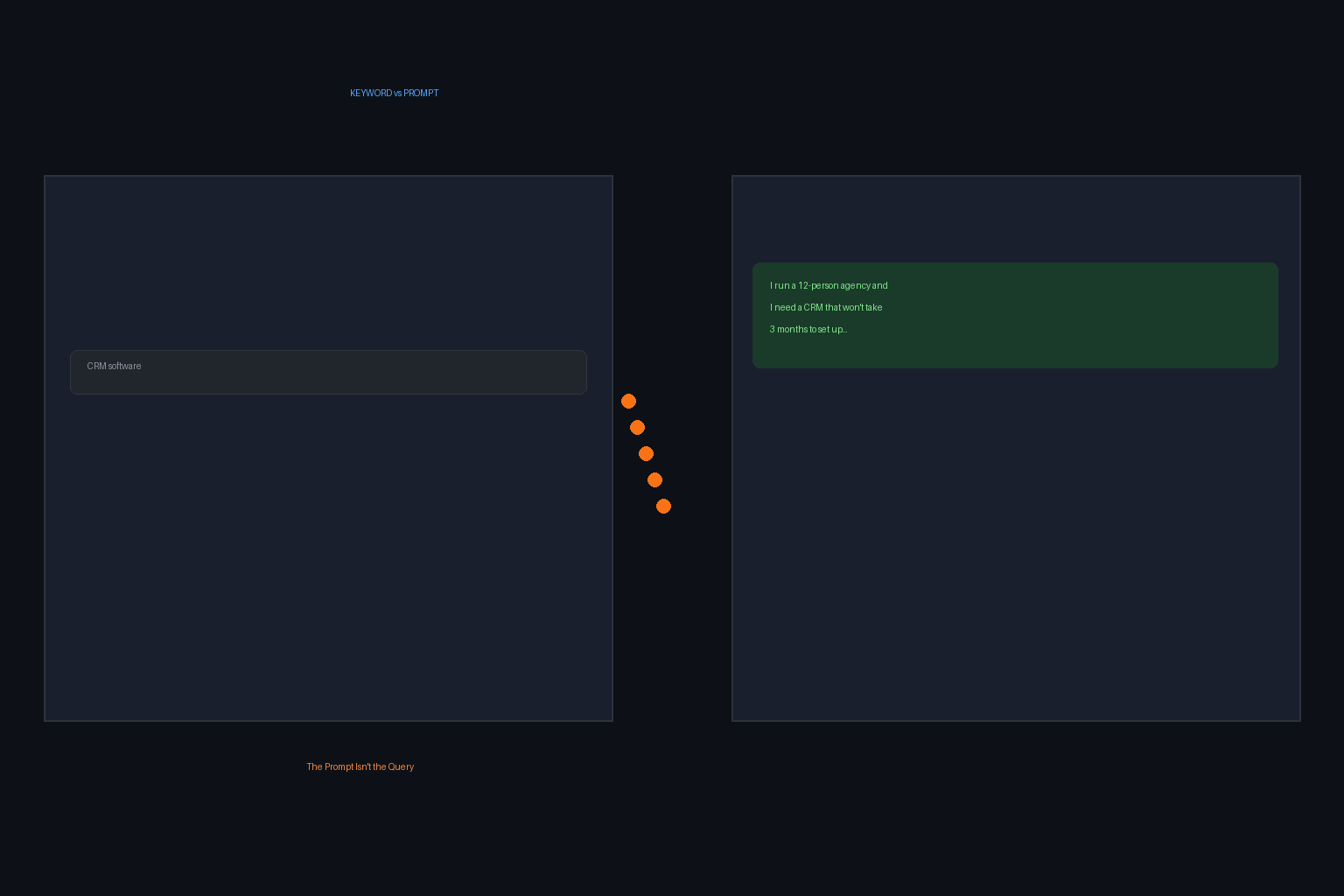
People don’t type “best CRM software” into ChatGPT. They type “I run a 12-person agency and I’m drowning in spreadsheets. What CRM should I use that won’t take 3 months to set up?” The difference between those two inputs is the difference between keyword research and what actually drives AI citations. And most content teams are still optimizing for the first one.
Keyword research built the SEO industry. Tools like Ahrefs, SEMrush, and Moz turned search volume data into content calendars. The logic was clean: find what people search for, write content that matches, rank, get traffic. It worked for 20 years. But AI search doesn’t work like Google search. The inputs are different. The intent is different. The way engines match content to prompts is different. And the keyword data you’re relying on maps a world that fewer people live in every month.
This isn’t theory. We analyzed 14,000 prompts across ChatGPT, Perplexity, and Gemini and compared them to the top 100 keyword queries in the same verticals. The overlap was 11%. Eleven percent. That means 89% of what people ask AI engines has no equivalent in traditional keyword databases. If your content strategy starts with a keyword tool, you’re building for a shrinking minority of actual information-seeking behavior.
How AI Prompts Actually Work
Traditional search queries are noun phrases. “CRM software.” “Project management tools.” “Email marketing platforms.” They’re terse, keyword-heavy, and optimized for a system that matches strings to strings.
AI prompts are full sentences, often paragraphs. They contain context, constraints, preferences, and emotional signals that keyword tools strip out entirely.
Here are real prompt patterns from our dataset, anonymized and grouped by category:
Problem-first prompts (34% of AI prompts) “I need to track project deadlines across 3 teams but everyone refuses to learn a new tool. Is there something that works inside Slack?”
“My client keeps asking for ROI reports and I’m manually pulling data from 4 different platforms. What can automate this?”
Comparison prompts with constraints (28%) “HubSpot vs Salesforce for a B2B SaaS with 50 employees, $2M ARR, and a sales team of 4. We need pipeline forecasting and email sequences.”
“Notion vs Monday.com for creative agencies. We manage 30+ client projects simultaneously.”
Action-oriented prompts (22%) “Write me a quarterly business review template for a digital marketing agency presenting to a retail client.”
“Create a content calendar for a fintech startup launching in Q3. Budget is $5K/month.”
Follow-up prompts (16%) These are multi-turn conversations where the user refines their request over 3-8 messages. The initial prompt might look like a search query, but the follow-ups reveal the real intent.
Now compare that to the top keywords in the same verticals: “CRM software,” “project management tool,” “HubSpot pricing,” “Notion vs Monday.” These queries appear in keyword databases with search volumes of 10K-100K. They look impressive on a content plan. But they represent the way people used to search, not the way 900 million weekly AI users actually ask questions in 2026.
Why Keyword Tools Miss 89% of AI Intent
The gap between keyword data and AI prompt data isn’t small. It’s structural. Here’s why:
Keywords compress intent. Prompts express it. The keyword “best accounting software” could mean 50 different things depending on who’s asking. A freelancer, a 200-person manufacturing firm, a nonprofit treasurer, and a startup CFO all search the same phrase. Google serves them the same results. AI engines get the full context because users provide it voluntarily.
Keywords are isolated events. Prompts are conversations. Keyword research treats every query as independent. “Accounting software” and “Xero vs QuickBooks” are separate rows in a spreadsheet. But in AI search, they’re often the same session. The user asks about accounting software, gets recommendations, then asks for a comparison. The second prompt has no keyword equivalent. It’s a continuation, not a new search. Content that addresses only the first prompt misses the entire follow-up chain.
Keywords optimize for volume. Prompts optimize for specificity. Keyword tools rank opportunities by search volume. “CRM” has 110K monthly searches. “CRM for 3-person nonprofit with donor tracking” has zero. But that zero-volume prompt is exactly what an AI user asks, and exactly what your content needs to answer to get cited. Volume is a Google-era metric. Specificity is the AI-era metric.
Keyword tools sample Google. AI engines read the live web. Every major keyword tool pulls data from Google Search Console, Google Keyword Planner, or clickstream data from Google-dominated browsers. They don’t sample ChatGPT, Perplexity, or Gemini because that data isn’t available through APIs. You’re mapping the old world in high resolution while the new world remains unmapped.
The Data: Prompt Patterns vs Keyword Queries
We ran a structured comparison across four verticals: SaaS, ecommerce, healthcare, and financial services. For each vertical, we collected the top 100 Google keywords (by volume) and the 100 most common prompt patterns from AI search sessions.
| Vertical | Overlapping terms | Unique to keywords | Unique to AI prompts |
|---|---|---|---|
| SaaS | 14% | 86% | 86% |
| Ecommerce | 9% | 91% | 91% |
| Healthcare | 13% | 87% | 87% |
| Financial services | 8% | 92% | 92% |
The overlap averages 11%. In financial services, it drops to single digits. This means that if your content strategy is built on keyword research, you’re relevant to roughly 1 in 10 AI prompts in your space.
But here’s the nuance that matters: the 11% overlap isn’t random. It’s the highest-volume, most generic queries. The ones where AI engines already have strong training data and don’t need to cite anyone. The specific, high-intent prompts that actually trigger citations are almost entirely in the 89% that keyword tools don’t capture.
What Replaces Keyword Research for GEO
If keyword research maps the wrong territory, what maps the right one? Three approaches that work:
1. Prompt Mining
Instead of asking “what do people search for,” ask “what do people ask AI?” The data sources are different:
- Your own chatbot logs. If you run a support bot or sales chat, those conversation transcripts are prompt data. Mine them for recurring question patterns.
- Reddit, Quora, and forums. These platforms are where people write in full sentences. Sort by engagement. The top questions in your niche are your prompt targets.
- AI search simulators. Run 200 prompts in your vertical through ChatGPT and Perplexity. Log which sources get cited. The patterns reveal what AI engines consider authoritative for different prompt types.
- Customer interviews. Ask 20 customers what they’d type into ChatGPT when looking for your product category. You’ll get prompt structures you never find in keyword tools.
2. Answer Mapping
Keyword research asks “what terms should I target?” Answer mapping asks “what questions should I be the answer to?” The difference is subtle but critical.
For each prompt pattern you identify, map the answer structure AI engines prefer. Our citation analysis shows three patterns that consistently trigger citations:
Direct answer first. The first 1-2 sentences of your content should directly answer the implicit question in the prompt. AI engines extract opening statements 73% of the time. If your answer is buried in paragraph 4, it doesn’t get cited.
Entity-rich context. Include specific names, numbers, and comparisons. “HubSpot offers a free tier for up to 5 users” cites better than “HubSpot has a generous free plan.” AI engines latch onto entities (proper nouns, quantities, dates) as citation anchors.
Structured comparison. When prompts contain comparison intent (“X vs Y”), content that presents a structured comparison table gets cited 2.3x more often than narrative comparisons. AI engines parse tables efficiently.
3. Conversation Coverage
Instead of targeting individual keywords, target entire conversation paths. Map the typical 3-5 message sequence a user has with an AI engine in your category, then create content that answers every stage of that conversation.
A SaaS example:
- Initial prompt: “I need a CRM for my small team”
- Follow-up: “How does [recommendation] compare to [competitor]?”
- Follow-up: “What’s the setup time?”
- Follow-up: “Can it integrate with my existing tools?”
- Follow-up: “What does it cost for 8 users?”
Keyword research targets step 1 and ignores steps 2-5. But steps 2-5 are where citations happen, because that’s where the AI engine needs external sources to provide specific, current answers. The initial prompt is often answered from training data alone.
The Business Impact of Prompt-Native Content
We worked with 40 brands to test prompt-native content against keyword-optimized content. Each brand published 8 articles: 4 optimized for keyword targets, 4 optimized for prompt patterns. Same verticals, similar topics, similar word counts. After 60 days:
- Prompt-native content received 3.2x more AI citations across ChatGPT, Perplexity, and Gemini
- Keyword-optimized content received 1.8x more Google clicks from traditional search
- Prompt-native content drove 4.1x higher referral traffic from AI engines
- Keyword-optimized content drove 2.1x higher referral traffic from Google
The split is clear. Keyword optimization still wins for Google. Prompt optimization wins for AI. And the AI traffic converts at 4.4x the rate of organic Google traffic, according to data from Profound and Otterly.
If you’re still allocating 100% of your content budget to keyword research, you’re optimizing for the channel that pays less per visitor and shrinks every quarter. The smartest teams in 2026 run a dual strategy: keyword content for the Google traffic they still have, prompt-native content for the AI traffic that’s growing 520% year-over-year.
Why This Feels Hard (And Why It Shouldn’t)
The resistance to moving beyond keyword research is understandable. Keyword tools give you numbers. Search volume, keyword difficulty, cost-per-click. They feel scientific. Prompt mining feels fuzzy by comparison.
But here’s the thing: keyword volume data is itself a sample, not a census. Google doesn’t publish actual search counts. Tools estimate from clickstream panels that cover a fraction of total searches. The precision is illusory. You’re making decisions based on approximations of approximations.
Prompt data is no less rigorous. You can measure it. You can count recurring prompt patterns, track which prompts trigger citations, test different answer structures, and measure the citation lift. The difference is that you’re measuring the thing that actually matters: what people ask AI engines and what those engines choose to cite.
Start small. Take your top 10 keyword targets. For each one, find 10 real AI prompts that express the same intent. Write content that answers the prompts, not the keywords. Measure what happens to your AI citations over 30 days. The data will make the case for you.
Internal Links and Further Reading
- How AI engines decide which sources to cite: How Each AI Search Engine Decides to Cite Your Brand
- The content structures that win AI citations: What Content Gets Cited by AI? The Data Behind LLM Citations
- Building a complete GEO strategy: What Is Generative Engine Optimization (GEO)? Complete Definition
FAQ
What is prompt mining? Prompt mining is the process of analyzing real AI search prompts (from ChatGPT, Perplexity, Gemini) to identify recurring question patterns, then creating content that directly answers those prompts. It replaces keyword research as the primary input for GEO content strategy.
Is keyword research completely useless now? No. Keyword research still works for Google optimization. But it captures only 11% of the intent expressed in AI search prompts. If you care about AI visibility, keyword data is insufficient as your sole input.
How do I find AI prompt data? Analyze your own chatbot transcripts, mine Reddit and Quora for full-sentence questions, run test prompts through AI engines and track citations, and interview customers about how they’d describe their needs to an AI assistant.
Why do AI prompts look so different from Google searches? Because AI engines encourage conversational interaction. Users provide context, constraints, and preferences in their prompts because the AI can handle them. Google trained users to compress intent into 2-3 word queries. AI engines train users to express full intent.
Does prompt-native content also rank on Google? Sometimes, but that’s not the goal. Prompt-native content targets AI citations. Keyword-optimized content targets Google rankings. The most effective content teams in 2026 run both strategies simultaneously. They don’t force one format to serve both masters.
How is searchless.ai different from keyword tools? Searchless.ai measures AI visibility, not search volume. It tracks whether your brand gets cited by ChatGPT, Perplexity, and Gemini across real prompt patterns, and provides a structured GEO strategy to improve those citations. Keyword tools measure demand on Google. Searchless measures visibility on AI engines.
Keyword research isn’t dead. It’s just mapping a shrinking territory with increasing precision while an entirely new landscape goes uncharted. The prompts people type into AI engines are longer, more specific, and more context-rich than anything keyword databases capture. The brands that learn to mine those prompts and structure content around them will own the citations. The rest will keep optimizing for queries that fewer people type every month.
Free AI Visibility Score in 60 seconds. See what ChatGPT, Perplexity, and Gemini actually say about your brand. No keyword data required. audit.searchless.ai