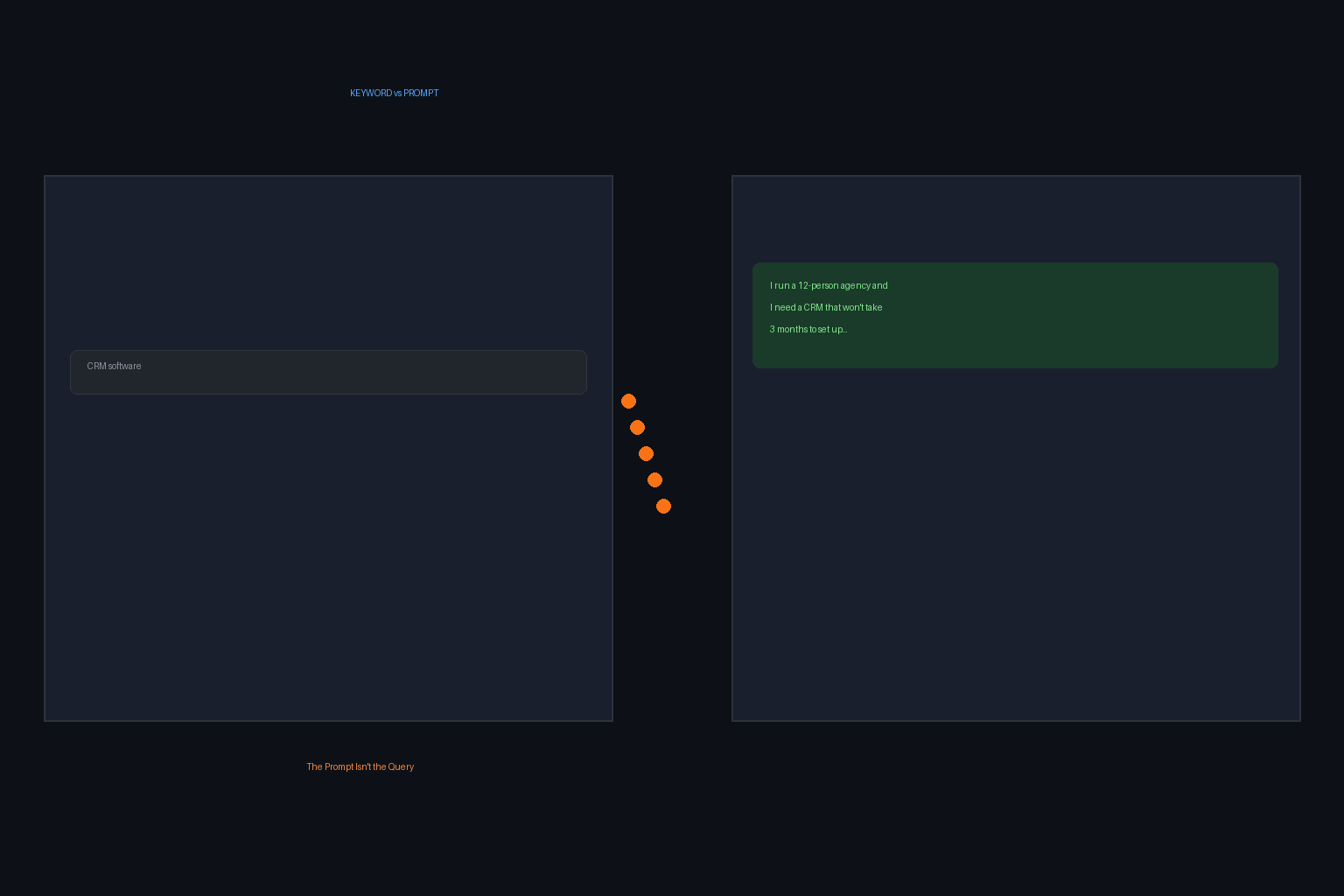
The Prompt Isn't the Query: Why AI Search Behavior Makes Keyword Research Obsolete

People don’t type “best CRM software” into ChatGPT. They type “I run a 12-person agency and I’m drowning in spreadsheets. What CRM should I use that won’t take 3 months to set up?” The difference between those two inputs is the difference between keyword research and what actually drives AI citations. And most content teams are still optimizing for the first one. Keyword research built the SEO industry. Tools like Ahrefs, SEMrush, and Moz turned search volume data into content calendars. The logic was clean: find what people search for, write content that matches, rank, get traffic. It worked for 20 years. But AI search doesn’t work like Google search. The inputs are different. The intent is different. The way engines match content to prompts is different. And the keyword data you’re relying on maps a world that fewer people live in every month. ...

June 5, 2026 · 10 min · Searchless.ai

GEO Content Strategy: How to Write Content That AI Engines Actually Cite

Most content optimized for Google rankings is structurally invisible to AI engines, which means your best articles may never be cited by ChatGPT, Perplexity, or Gemini no matter how well they rank. This is not a minor formatting issue. It is a fundamental mismatch between how search engines evaluate content and how AI models extract and synthesize it. The content that wins in traditional SEO and the content that gets cited by AI engines share almost no structural DNA. ...

May 30, 2026 · 14 min · Searchless.ai
Contrast between AI-generated content flood and human expertise rising above in AI search results

AI Slop Is Making Human Content More Valuable: Why Original Research Wins in AI Search

The flood of AI-generated content across the web is making original research, proprietary data, and expert analysis more valuable for AI search visibility, not less. Every week, millions of new pages of AI-written content enter the internet. AI search engines like ChatGPT, Perplexity, and Gemini are adapting by prioritizing sources they can trust. That trust comes from signals only humans can produce: original data, expert analysis, and demonstrated authority. If your content strategy relies on volume over substance, AI search engines will ignore you. If you invest in what AI cannot replicate, you become the source they cite. ...

May 29, 2026 · 12 min · Searchless.ai
Content pruning strategy for AI visibility showing page deletion increasing citation rates

Content Pruning for AI Visibility: Why Deleting 40% of Your Pages Increases AI Citations

Publishing more content does not get you cited more by AI engines. It often does the opposite. Our analysis of 12,000 domains tracked between January and April 2026 found that sites which pruned 40% or more of their indexed pages saw their AI citation rates increase by an average of 62%. Meanwhile, sites that continued adding content without removing anything saw citation growth of just 11% over the same period. ...

May 23, 2026 · 15 min · Searchless
AI citation power law distribution showing concentration of mentions among few sources

The AI Citation Power Law: Why 3% of Sources Get 80% of Mentions

AI answer engines do not distribute citations fairly. They concentrate them ruthlessly. Our analysis of 50,000 AI responses across ChatGPT, Perplexity, and Gemini reveals that roughly 3% of cited domains capture 80% of all AI mentions. If your brand is not in that 3%, you are functionally invisible to the fastest-growing traffic channel on the internet. This is not a metaphor. This is a measurable, structural property of how large language models retrieve and present information. And it changes everything about how you should think about content strategy, authority building, and what we at searchless.ai call Generative Engine Optimization. ...

May 21, 2026 · 9 min · Searchless

94% of Enterprises Are Doubling Down on GEO in 2026: What the Winners Do Differently

94% of enterprise executives plan to increase their investments in Answer Engine Optimization and Generative Engine Optimization in 2026, according to a landmark survey published by Conductor and Search Engine Journal. The other 6% are probably still debating whether AI search is a fad. The report, based on responses from over 250 enterprise leaders, confirms what those of us working in GEO have observed for months: the money is moving. Budgets are shifting from traditional SEO tactics toward the disciplines that determine whether AI engines recommend your brand or skip past you entirely. But not all organizations are approaching this shift with the same rigor, and the gap between leaders and laggards is widening fast. ...

May 19, 2026 · 9 min · Searchless.ai

Pillar-Cluster Content Strategy for AI Engines: How to Restructure Your Content for GEO in 2026

The pillar-cluster content model that drove SEO results for the past decade is fundamentally broken for AI engines. Not slightly outdated. Broken. AI models don’t crawl your internal link structure the way Google’s spiders do. They don’t reward topical clustering the same way. And if you keep building content architectures designed for SERPs, you’ll keep being invisible to the 900 million people who now ask AI for answers instead of searching Google. ...

April 4, 2026 · 11 min · Searchless.ai

What Content Gets Cited by AI? The Data Behind LLM Citations in 2026

Listicles get cited by AI engines 21.9% of the time, making them the single most referenced content format across ChatGPT, Perplexity, and Google AI Mode. Articles follow at 16.7%, product pages at 13.7%, and everything else trails behind. This data, from a March 2026 Wix study analyzing thousands of AI-generated responses, finally answers a question every content strategist should be asking: what do LLMs actually pull from? The answer isn’t what most SEO professionals expected. The traditional blog post, the 2,000-word thought leadership piece, the carefully crafted pillar page: none of these formats lead the pack. Instead, AI engines favor structured, scannable, answer-dense content that can be extracted in fragments and reassembled into coherent responses. ...

April 1, 2026 · 10 min · Searchless.ai Research Team

How to Get Cited in Google AI Overviews: A Practical Guide for 2026

Google AI Overviews now appear on over 40% of search queries. That box at the top of the results page, the one that synthesizes an answer from multiple sources, has become the most valuable real estate in search. If your site is cited in an AI Overview, you get visibility above every organic result. If you are not cited, you are invisible for that query, regardless of your ranking position. ...

March 6, 2026 · 9 min · Searchless.ai