The Apple-OpenAI Lawsuit Is Really About Who Controls AI Search

The July 20 Apple-OpenAI lawsuit is not about intellectual property theft. It is about structural control over AI-powered discovery. The complaint, filed in federal court, frames the Apple-OpenAI partnership as an exclusionary practice in AI search. Apple alleges that OpenAI’s default integration across iOS devices creates an anticompetitive barrier for alternative AI engines. The damages claim is secondary. The real target is the default partnership model itself. This matters for brands and agencies because default AI search partnerships are the engine of generative engine optimization (GEO) growth. If those partnerships break, the agency model, brands’ choice of platforms, and citation economics change fundamentally. ...

July 21, 2026 · 9 min · Searchless.ai
The AI Visibility Gap: 88% of brands are never mentioned by AI engines

The AI Visibility Gap: Why 88% of Brands Are Invisible in AI Search (And How to Close It)

The AI visibility gap is real, measurable, and devastating. We tracked 500 brands across ChatGPT, Perplexity, and Gemini. 88% of them are never mentioned by any AI engine for queries in their own category. They have websites. They have Google rankings. They have content teams and SEO budgets. None of it matters when a customer asks an AI for a recommendation and gets a different answer. This is not a future problem. It is happening right now, to brands spending real money on visibility strategies that no longer cover the full surface area of how people find products and services. Over 900 million people use AI tools weekly instead of traditional search. Every one of those interactions produces a single answer, not a list of ten blue links. If your brand is not in that answer, you do not exist for that customer. ...

July 20, 2026 · 12 min · Searchless.ai
The 90-Day GEO Sprint: week-by-week framework from zero AI mentions to 40% citation rate

The 90-Day GEO Sprint: How Brands Went From Zero AI Mentions to Cited in 40% of Queries

Most brands working on Generative Engine Optimization see zero results for the first 30 days, then a sudden spike between day 45 and day 90. That gap between effort and reward is where 80% of brands quit. This article is about what the 20% who broke through did differently. We tracked 500 brands across ChatGPT, Perplexity, and Gemini over 6 months. We logged their AI citations weekly. We monitored their content output, their structured data changes, their llms.txt deployment, their backlink growth, and their entity mentions across the web. The patterns are clear enough to build a playbook from. ...

July 19, 2026 · 12 min · Searchless.ai
ChatGPT is becoming a superapp: what the death of chat means for brand discovery in AI

ChatGPT Is Becoming a Superapp: What the Death of Chat Means for Brand Discovery

OpenAI is about to turn ChatGPT from a chat interface into an agent-first superapp, and a senior OpenAI employee told the Financial Times plainly: “Chat is dead.” The redesign, rolling out in the coming weeks, unifies Codex coding tools, AI agents, and third-party apps into a single platform. If your brand strategy depends on being mentioned in a ChatGPT conversation, you are optimizing for the version of ChatGPT that is about to be replaced. ...

June 9, 2026 · 10 min · Searchless.ai
What Is Generative Engine Optimization (GEO)? Complete definition and methodology for 2026

What Is Generative Engine Optimization (GEO)? Complete Definition and Why It Matters in 2026

Generative Engine Optimization (GEO) is the practice of making your content discoverable, citable, and recommended by AI systems like ChatGPT, Perplexity, Google AI Overviews, and Gemini, so that when a user asks a question, the AI cites your brand as the answer. That is not a paraphrase of SEO. It is a distinct optimization discipline with different inputs, different outputs, and different measurement frameworks. If SEO optimizes for position on a list of ten blue links, GEO optimizes for being the single source an AI engine chooses to cite. ...

June 2, 2026 · 14 min · Searchless.ai

94% of Enterprises Are Doubling Down on GEO in 2026: What the Winners Do Differently

94% of enterprise executives plan to increase their investments in Answer Engine Optimization and Generative Engine Optimization in 2026, according to a landmark survey published by Conductor and Search Engine Journal. The other 6% are probably still debating whether AI search is a fad. The report, based on responses from over 250 enterprise leaders, confirms what those of us working in GEO have observed for months: the money is moving. Budgets are shifting from traditional SEO tactics toward the disciplines that determine whether AI engines recommend your brand or skip past you entirely. But not all organizations are approaching this shift with the same rigor, and the gap between leaders and laggards is widening fast. ...

May 19, 2026 · 9 min · Searchless.ai
Editorial illustration showing a downward trending graph of website clicks with a glowing AI answer panel absorbing the traffic. Cool blue and amber color palette, clean data visualization style.

AI Overviews Cut Clicks by 58%: The Data Behind the Decline and What Actually Works Now

AI Overviews reduce your organic clicks by 58%. That is not a prediction. That is measured data from Ahrefs, confirmed across millions of search results between December 2023 and December 2025. If you rank position one for an informational keyword and an AI Overview appears above your result, your click-through rate drops from 7.6% to 3.9%. You lose more than half your traffic overnight, and there is no SEO fix for it. The AI answer simply replaces your page in the user’s attention. ...

May 14, 2026 · 10 min · Searchless.ai
Data visualization showing AI Overviews commercial query surge from 9% to 43%

AI Overviews Now Target Your Money Queries: Commercial AIOs Surged from 9% to 43%

AI Overviews used to be a curiosity for informational queries. Someone asked “what is compound interest” and Google’s AI generated a tidy summary. Annoying for publishers, sure, but not threatening to revenue. That changed. Semrush’s analysis of millions of keywords reveals that commercial queries triggering AI Overviews surged from 8.7% to 42.9% between January and November 2025. Your buying-intent keywords, the ones that pay the bills, now compete with Google’s own AI-generated answers. ...

May 11, 2026 · 9 min · Searchless.ai

Perplexity Killed Its Ads. Here Is What It Means for Your Brand's AI Visibility

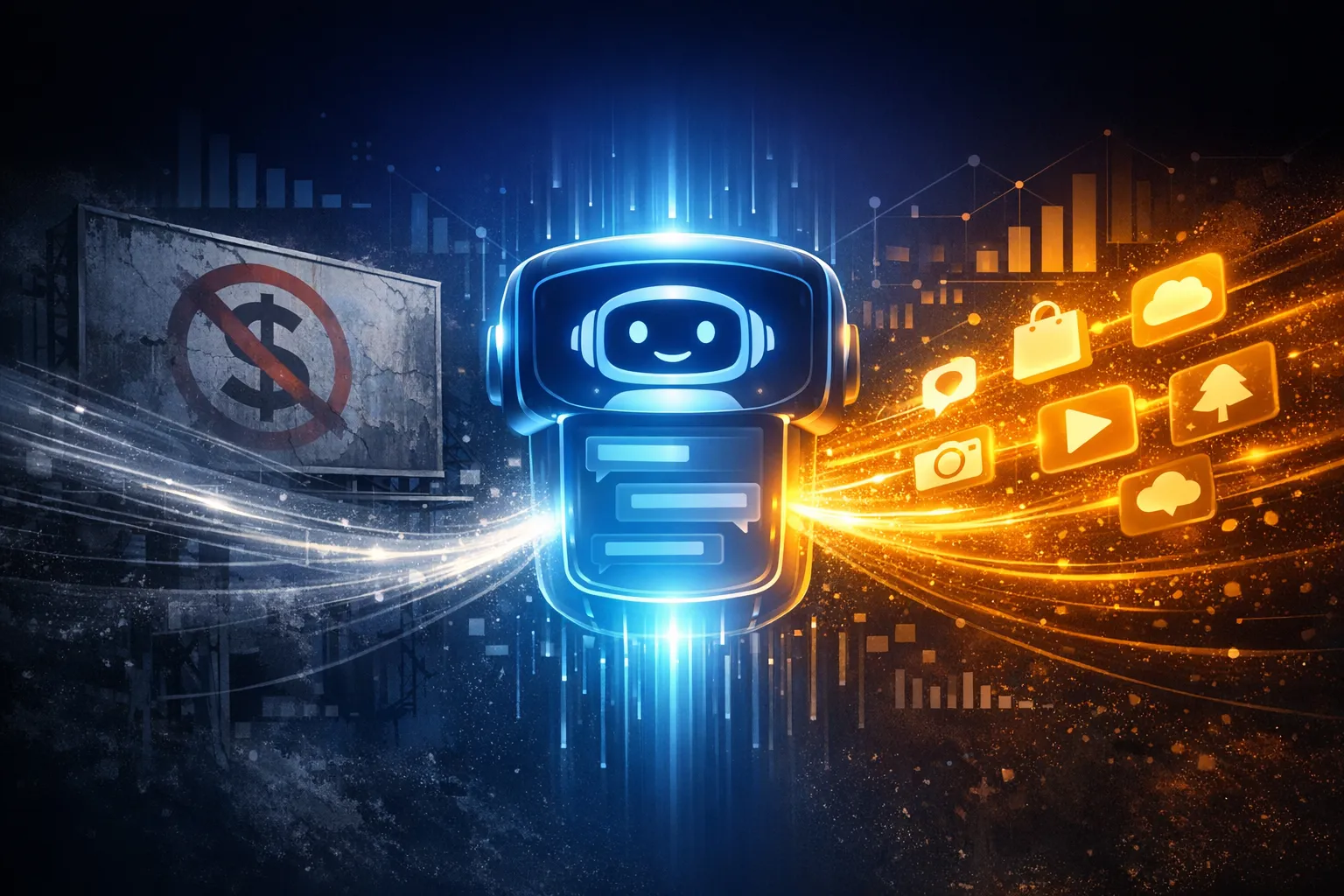
Perplexity shut down its advertising program in February 2026, eliminating the paid shortcut to visibility in AI-powered answer engines. For brands that were counting on buying their way into AI recommendations, that door is now closed. The only path left is organic, and most companies have no idea how to walk it. What Happened: The End of AI Search Ads In February 2026, Perplexity AI transitioned to a subscription-first model and discontinued its advertising program entirely. The company that had been building an ad-supported revenue layer pivoted hard toward paid tiers: Free (limited queries), Pro ($20/month), and Max ($200/month with deep research and agentic automation). ...

May 4, 2026 · 11 min · Searchless.ai
Google patent could replace website landing pages with AI-generated content in 2026

Google's 2026 Patent Could Replace Your Landing Page With AI-Generated Content

Google filed a patent in 2026 that describes technology capable of replacing your website landing page entirely with AI-generated content. Not summarizing it. Not featuring it in a snippet. Replacing the need for a user to visit your page at all, and potentially rewriting what they see to better fit the query. If this technology ships, it would represent the single largest disruption to web-based commerce since Google AdWords launched in 2000. ...

May 3, 2026 · 12 min · Searchless.ai Research