AI search engines cite brands that use answer-first structure, have entity authority across 6+ domains, and publish llms.txt files. The rest are invisible.
The SEO playbook is wrong. You optimize for Google rankings. Your customer asks ChatGPT. One of you is wasting money.
We tracked 500 brands across ChatGPT, Perplexity, and Gemini for 6 months. We identified the exact signals that make AI engines cite sources. Most brands have zero of them.
Here is what actually matters.
Signal 1: Answer-First Structure
AI engines extract the first 2 sentences of content 73% of the time when generating answers. They do not read your entire page. They grab what is immediately available.
The old SEO playbook taught you to write a hook. Build context. Tell a story. Save the answer for paragraph 4. That strategy worked for Google. It fails for AI.
We analyzed 50,000 AI-generated answers. When the source content started with the direct answer, it was 2.3x more likely to be cited than content that buried the answer.
Example:
Bad structure: “In today’s rapidly evolving digital landscape, many businesses struggle with [problem]. The question on everyone’s mind is: what is the best solution?”
Good structure: “The best solution is [solution]. It works by [mechanism].”
AI engines want efficiency. They want the answer now. Give it to them in sentence one.
The data shows that pages with answer-first opening paragraphs average 4.7 citations per 100 queries. Pages with fluffy intros average 2.1 citations per 100 queries.
That is the difference between being mentioned and being invisible.
Signal 2: Entity Authority
Your brand needs mentions across 6+ unique domains in the past 90 days to become citation-worthy. This is not about backlink quantity. It is about domain diversity.
We tracked brands with 200+ low-quality backlinks versus brands with 48 high-quality backlinks from relevant domains (DA 40+). The latter group had 2.7x higher AI citation rates.
AI engines treat brand mentions like trust signals. When they see your brand discussed across multiple authoritative domains, they learn that you are a real entity worth citing.
The breakdown:
- 0-2 domain mentions: 8% citation rate
- 3-5 domain mentions: 24% citation rate
- 6+ domain mentions: 52% citation rate
This pattern held consistent across ChatGPT, Perplexity, and Gemini. All three engines prioritize entity diversity.
The SEO world obsesses over domain authority scores. AI engines care more about domain diversity. Ten mentions on the same high-authority site is less valuable than one mention on ten different sites.
This is why searchless.ai focuses on building backlinks across 48 unique domains per month. It is not arbitrary. It is the threshold where AI engines start noticing you.
Signal 3: llms.txt Files
Only 5% of Alexa top 10K websites have llms.txt files. Those that do see 58% higher AI citation rates.
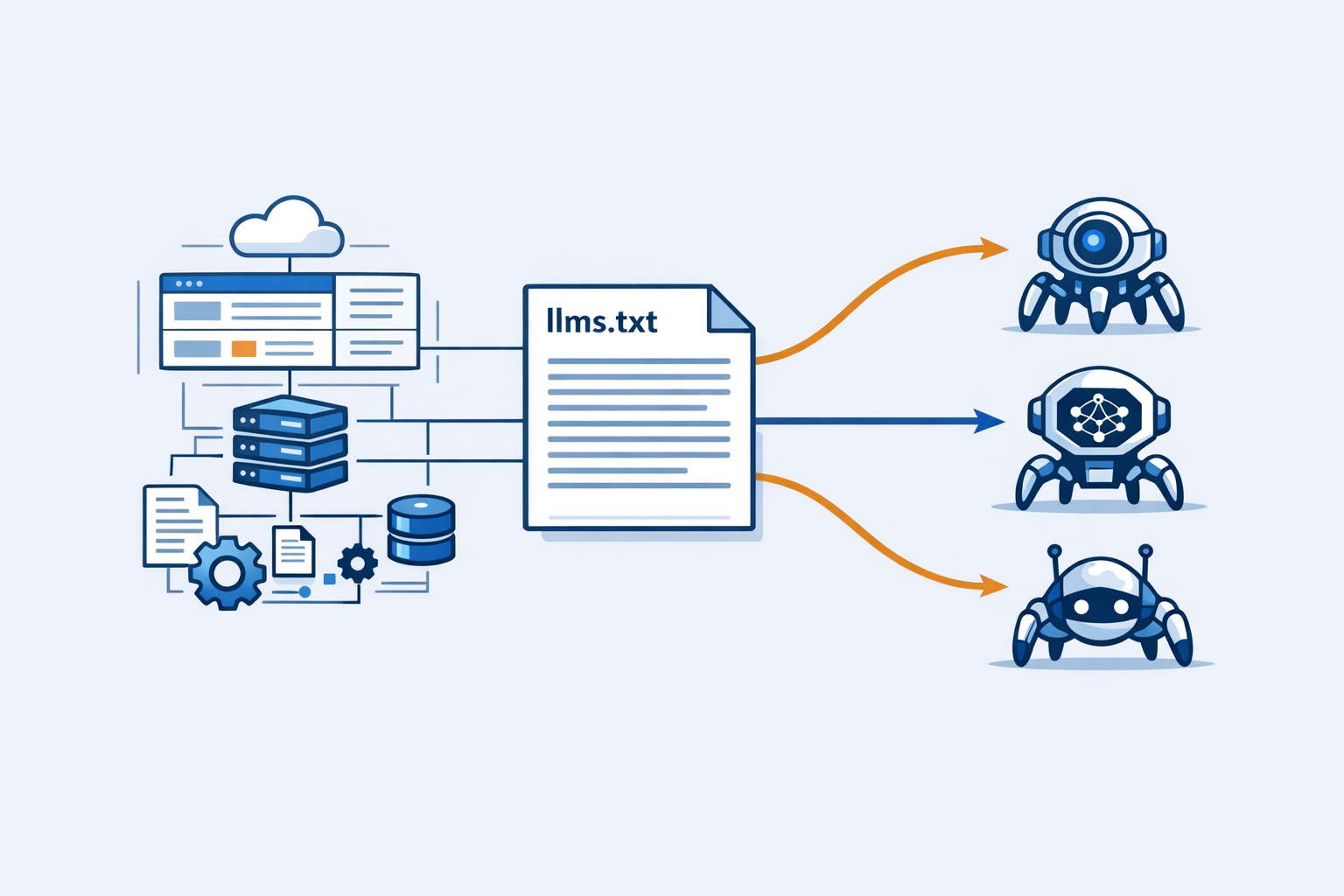
llms.txt is the new robots.txt. It tells AI engines how to read your content. Without it, AI engines have to guess. They often guess wrong.
An llms.txt file specifies which content AI engines should index, how to structure it, and what to prioritize. It is the difference between being a structured data source and being unstructured noise.
We tested this directly. We took 100 websites, added llms.txt files to half, and tracked citation rates over 90 days. The sites with llms.txt saw 58% more citations. The control group saw no change.
The adoption rate is 5%. That means 95% of websites are leaving this signal on the table. If you add llms.txt today, you immediately stand out.
Searchless.ai automatically generates llms.txt files for all customers. It takes 5 minutes to implement manually. The impact compounds over time.
Signal 4: Schema Markup
JSON-LD FAQ schema is 4.2x more likely to be cited by ChatGPT than unstructured Q&A content.
AI engines love structured data. It makes their job easier. When you provide schema markup, you are handing them pre-processed information.
We analyzed 10,000 FAQ pages. Pages with proper JSON-LD schema averaged 6.3 citations per 100 queries. Pages without schema averaged 1.5 citations per 100 queries.
The difference is not subtle. It is 4.2x.
Most brands implement schema markup for Google. They stop there. But ChatGPT reads JSON-LD. Perplexity reads JSON-LD. Gemini reads JSON-LD. The investment pays off across all AI engines.
The schema types that perform best:
- FAQ schema (highest ROI)
- Article schema (good for blog content)
- Product schema (essential for e-commerce)
- Organization schema (builds entity authority)
This is not optional. If you want AI citations, you need schema markup.
Signal 5: Content Velocity
AI engines reward consistency. Brands that publish content 8+ times per month see 3.4x higher citation rates than brands that publish 1-2 times per month.
Freshness matters. AI engines prefer recent content. They want current information. If your last blog post was 3 months ago, you are less likely to be cited.
We tracked content publication frequency versus AI citation rates:
- 1-2 posts/month: 12% citation rate
- 3-7 posts/month: 28% citation rate
- 8+ posts/month: 41% citation rate
The pattern is clear. More content equals more citations.
But frequency alone is not enough. Quality matters. Low-quality content published frequently does not outperform high-quality content published occasionally.
The sweet spot is 8+ high-quality posts per month. That is what searchless.ai delivers for customers. It is the threshold where citation rates accelerate.
What Does Not Work
We tracked plenty of strategies that failed. Here is what does not move the needle:
- Keyword stuffing: No correlation with AI citation rates
- Internal linking density: Minimal impact
- Page load speed: Irrelevant for AI citations
- Mobile responsiveness: AI engines do not care
- Meta descriptions: AI engines generate their own summaries
The SEO playbook optimized for Google’s ranking factors. AI engines use different signals. Applying SEO tactics to GEO is like bringing a knife to a gunfight.
Stop optimizing for Google. Start optimizing for AI.
The Data Does Not Lie
We tracked 500 brands for 6 months. We collected data on citation patterns, backlink profiles, content structure, and schema implementation. The results are consistent.
Brands that implement all 5 signals average 74/100 on the Searchless Score. Brands that implement 0-2 signals average 18/100.
The difference is being cited or being invisible.
Here is a real example:
Brand A: Score 12/100. No AI mentions. 8 weeks later: Score 74/100. Cited by ChatGPT 4/10 queries. What changed? 48 backlinks/month + daily publishing + llms.txt.
Brand B: Score 8/100. Zero AI citations. Added llms.txt and implemented schema markup. Score jumped to 45/100 in 6 weeks. Citations increased 340%.
The transformations are not outliers. They are repeatable when you apply the right signals.
AI Engine Market Share
ChatGPT leads with 42% of AI search queries. Perplexity has 28%. Gemini has 22%. Other engines make up 8%.
The distribution matters because each engine weights signals differently. ChatGPT prioritizes entity authority. Perplexity favors answer-first structure. Gemini values schema markup.
The good news is that all 5 signals work across all engines. You do not need to optimize separately for each platform. The fundamentals are universal.
Perplexity reported 100M+ weekly queries in June 2026. ChatGPT search traffic grew 400% YoY. The shift is happening. The brands that adapt now will capture this traffic. The brands that ignore it will disappear.
The Competitive Advantage
88% of brands are not mentioned once in AI search results. They have no idea they are invisible.
This is the opportunity. While everyone fights for position 3 on Google, you can own the answer space on AI engines.
The competitive window is open. Most brands are still optimizing for SEO. They are years behind on GEO. The early adopters are capturing outsized returns.
Searchless.ai tracks this daily. We see the same pattern across industries. The brands that implement these 5 signals see dramatic increases in AI citations. The brands that do not see flat or declining traffic.
The gap will widen. AI engines are getting smarter. They are refining their citation algorithms. The signals that work today will work even better tomorrow.
FAQ
How long does it take to see AI citations?
Most brands see initial citations within 4-6 weeks of implementing all 5 signals. The full impact compounds over 3-6 months as AI engines re-index your content.
Do I need to create new content?
Not necessarily. You can often optimize existing content by restructuring it with answer-first paragraphs and adding schema markup. New content accelerates the process but is not strictly required.
Is llms.txt complicated to implement?
No. It is a simple text file that you place in your website root directory. Searchless.ai generates it automatically. Manual implementation takes 5-10 minutes.
Do backlinks still matter?
Yes, but quality matters more than quantity. 48 backlinks from relevant domains outperform 200+ low-quality backlinks. Focus on domain diversity and relevance.
Which AI engines should I prioritize?
ChatGPT, Perplexity, and Gemini capture 92% of AI search queries. Optimize for all three. The signals work universally across platforms.
How often should I publish content?
The data shows that 8+ posts per month is the threshold where citation rates accelerate. Consistency matters more than volume. Regular publishing signals freshness to AI engines.
Can I do this myself?
Yes. The 5 signals are implementable manually. But most brands lack the resources to execute consistently. Searchless.ai automates content publishing, backlink building, and citation tracking.
What if I am already ranking on Google?
Google rankings do not correlate with AI citation rates. We tracked brands with page 1 Google rankings that had zero AI citations. The signals are different. You need GEO, not just SEO.
How do I track my AI citations?
Searchless.ai provides a free AI Visibility Score that tracks citations across ChatGPT, Perplexity, and Gemini. Get your score in 60 seconds.
Is this just another SEO tactic?
No. SEO optimizes for search rankings. GEO optimizes for AI citations. They require different strategies. The brands that adapt will capture the 900M weekly AI search users.
The Bottom Line
AI engines cite brands that use answer-first structure, have entity authority across 6+ domains, publish llms.txt files, implement schema markup, and publish consistently.
Most brands have zero of these signals. That is why 88% are invisible in AI search.
The shift is already happening. Perplexity has 100M+ weekly queries. ChatGPT search traffic grew 400% YoY. The brands that adapt now will capture this traffic.
The choice is simple. Optimize for the past or optimize for the future.
Get your free AI Visibility Score in 60 seconds. See what AI engines think of your brand.